
Best Epoxy Putty in 2026

A split pipe, holed gutter or chipped casting does not always mean a new part. The best epoxy putty in 2026 is a hand-kneaded stick that fills, bonds and cures hard enough to drill, sand and paint. This UK guide compares British epoxy putty for metal, plastic and wet leaks, and shows where a stick earns its keep on everyday jobs.
Epoxy putty formulations differ in strength, working time and the materials they are designed to repair. A closer look at the best epoxy putty stick covers versatile hand-kneaded repair options, while the guide to the best metal epoxy putty focuses on formulations suited to metal repairs and restoration.
Discover the Best Epoxy Putty in 2026 - Jenolite.
What Epoxy Putty Actually Does

Epoxy putty is a two-part resin and hardener already packed in the right share. You cut a piece, knead until the colour is one shade, then press it into the damage. It is a filler and a rebuild material, not a thin glue. A smear in a hairline crack will not do the work of a packed hole.
The best epoxy putty in 2026 for a given job is the one filled for that surface. A steel stick suits steel. A copper stick suits brass, bronze and copper pipe. Plastic, aluminium and underwater grades exist because a general stick is a compromise. Once hard, a good stick can be filed, drilled, tapped and painted. Many household fixes, from a weeping elbow to a chipped alloy frame, never need a welder.
Used as a permanent filler, epoxy putty sticks replace material that has broken off, gouged out or worn away. They are a poor choice as a structural weld on a loaded joint. Pair the fill with a sound surface and, on rusty steel, a proper clean first.
How To Match A Stick To The Job
Match the filler to the part, then match the speed to the repair.
-
Metal. Steel, aluminium, copper and titanium sticks carry a metal filler so the repair behaves more like the part. Metal epoxy putty is the right family for pipes, casings, frames and castings.
-
Plastic and fibreglass. A plastic grade bonds to many rigid and semi-flexible plastics. Polythene and polypropylene still resist most epoxies.
-
Wet work. An underwater grade can be pressed on in fresh or salt water. Ordinary sticks prefer a dry, clean face.
-
Wood and ceramics. Fine grades fill knot holes and chips, then take paint or varnish. Filling holes in wood works best when the timber is not soaking wet.
-
Heat. Check the grade. A steam pipe needs a high-heat stick. A cold water tank does not.
Work time is the other choice. A fast stick is ready in minutes and punishes slow hands. A long-open putty gives you time to shape a large void. Cold rooms slow the cure. Warm hands speed it up.
How To Apply Epoxy Putty On A Leaking Pipe
A pipe repair fails more often from a wet, greasy face than from a weak stick. Shut the water off first. Even a slow drip lifts fresh putty before it can grab.
-
Stop the flow. Turn the nearest isolation valve, or the main stopcock if the branch has no valve. Open a tap below the repair so leftover water drains out.
-
Clean the pipe. Wipe off grease, limescale and loose rust. Sand lightly so the stick has a key. Dry the face with a cloth unless the grade is made for wet use.
-
Knead a small piece. Cut only what you can place. Knead until the colour is even, usually a minute or two. Wear gloves. Uncured epoxy can irritate skin.
-
Pack the damage. Press hard into the hole or crack, then wrap a little past the sound metal either side. Smooth it so there are no air pockets on the curve.
-
Wait before the water goes back on. Fast metal sticks often feel firm in about 20 to 60 minutes. Full strength takes longer. Cold cellars slow this. Do not test the joint while it is still soft.
A dry face still beats a wet one, even with a wet-rated stick. A few seconds with a cloth makes the bond last longer. If you cannot stop the water at all, an underwater epoxy putty can be pressed on in fresh or salt water and held until it grabs.
Best Epoxy Putty in 2026
1. Jenolite Epoxy Putty - Best Epoxy Putty in 2026
Jenolite epoxy putty are hand-mixed compounds made in Britain for jobs that need more than a smear of glue. Cut a piece, knead until the colour is even, then press the putty into a crack, hole or broken edge. Matching sticks cover steel, aluminium, copper, titanium, plastic and underwater work, so the bond suits the surface. The steel grade holds up to 149°C. The titanium grade is built for hotter jobs, up to 260°C. The underwater grade can go on in fresh or salt water, a useful fix for hulls, pools, tanks and gutters. Once cured it is waterproof and can be sawn, drilled, tapped, filed and painted. Metal grades often reach functional strength in about 60 minutes. Jenolite is a British family-owned company in Biggleswade.
Epoxy Putty Repair Sticks | 7 Inch (112g) Tube | Plastic, Steel, Underwater, Copper, Aluminium, Titanium
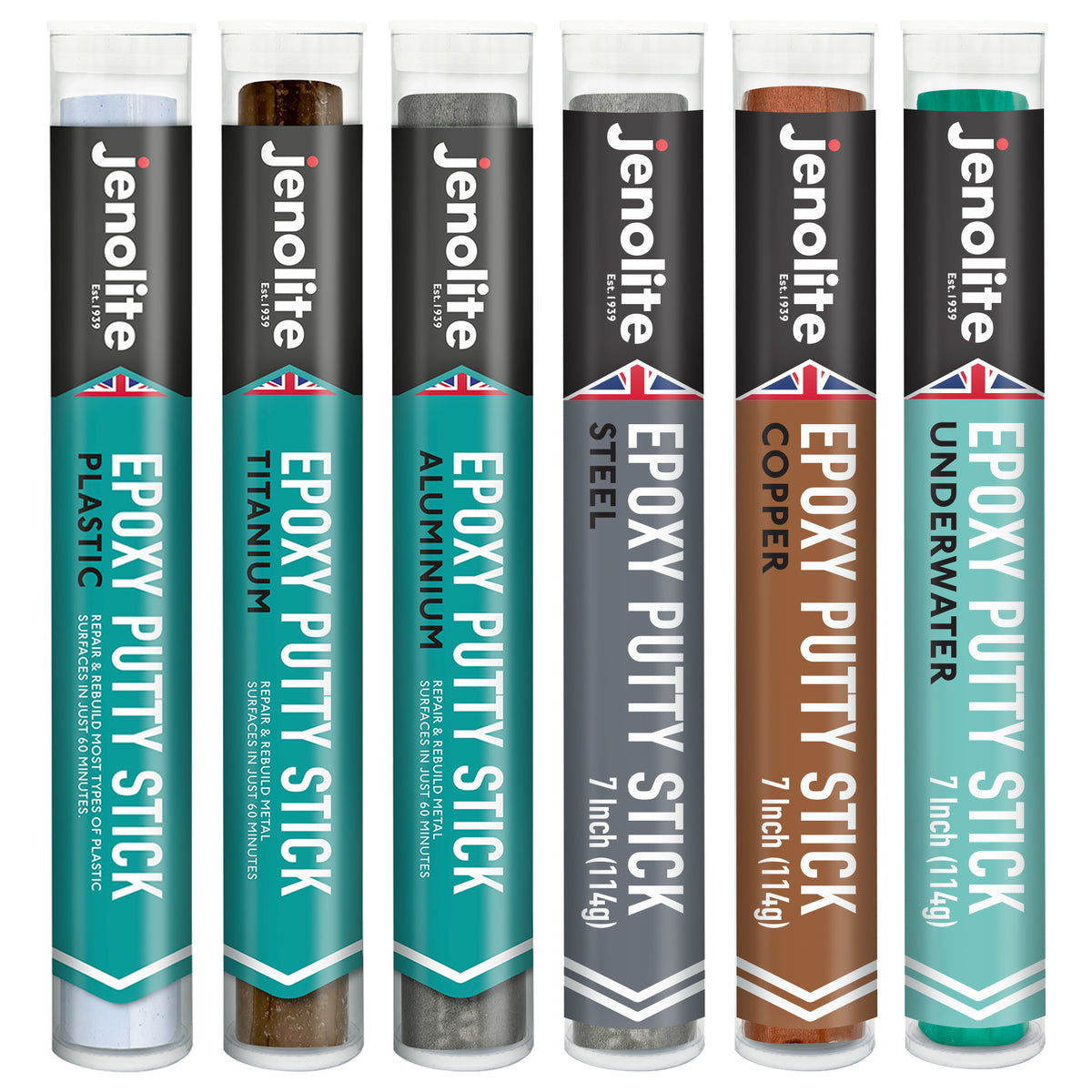
Description (Epoxy Putty Repair Sticks | 7 Inch (112g) Tube | Plastic, Steel, Underwater, Copper, Aluminium, Titanium):
-
HAND MIX & APPLY: JENOLITE Epoxy Putty Sticks are two-part epoxy repair sticks that you knead by hand, then press into place to rebuild, fill and bond damaged parts.
-
MULTI-SURFACE APPLICATIONS: Each stick is made for a specific substrate, covering metal, steel, aluminium, copper, titanium, plastic, fibreglass, ceramics and similar materials.
-
WEATHER PROOF & RESISTANT TO CORROSION: Suitable indoors and outdoors. The cured epoxy putty resists water, chemicals and temperature extremes.
-
FAST ACTING: Usable within minutes and typically fully functional in 60 minutes. Check the technical data sheet for exact cure times by variant.
-
DURABLE: Hand-mix the two parts into a polymer compound, then mould, wrap or build it up to join and repair components. Once fully cured it is waterproof and can be sanded, sawn, drilled and painted.
-
PLASTIC EPOXY PUTTY: A two-component stick for repairing and rebuilding most major plastic types. After mixing, the fast-setting epoxy bonds to rigid and semi-flexible plastic and can be moulded, wrapped or built up to restore the damaged area.
-
TITANIUM EPOXY PUTTY: A non-rusting, titanium-reinforced epoxy for cracked, snapped or holed metal. Industrial-strength and rated for high-temperature use up to 260°C. Functional after 60 minutes. Once fully cured it is waterproof and can be drilled, tapped, machined, ground, filed and painted.
-
ALUMINIUM EPOXY PUTTY: A non-rusting, aluminium-reinforced epoxy for scratched, chipped or cracked metal. Mix by hand and apply straight to the repair. Once fully cured it can be drilled, tapped, machined, ground, filed and painted. A practical workshop repair stick for mechanics.
-
STEEL EPOXY PUTTY: A non-rusting, steel-reinforced epoxy for rebuilding and repairing metal. Mix by hand and press onto scratched, chipped or cracked areas. Industrial-strength, withstands temperatures up to 149°C, and is functional after 60 minutes. Once fully cured it is waterproof and can be drilled, tapped, machined, ground, filed and painted.
-
COPPER EPOXY PUTTY: A two-component stick for pipes, tanks, hot lines and vessels in brass, copper, bronze and other non-ferrous metals. Use it on plumbing elbows, sinks, taps and water heaters, and to seal freeze breaks. Hand-mix, mould to the joint, and once fully cured it is waterproof and can be sanded and painted. A plumber’s epoxy for leaking hot pipework.
-
UNDERWATER EPOXY PUTTY: A hand-mixable epoxy for damp, wet and submerged repairs in fresh or salt water. Bonds to fibreglass, concrete and similar substrates. Suited to marine decks and hulls, swimming pools, hot tubs, spas, recreational equipment, and leaking tanks and gutters. Functional after 60 minutes. Once fully cured it is waterproof and can be drilled, tapped, machined, ground, filed and painted.
-
MADE IN THE UK
-
Please note: Packaging may differ from the images shown because of label updates. Contents and quality are unchanged.
Green Stuff | Epoxy Putty Roll | Blue & Yellow Strip | 36 Inch 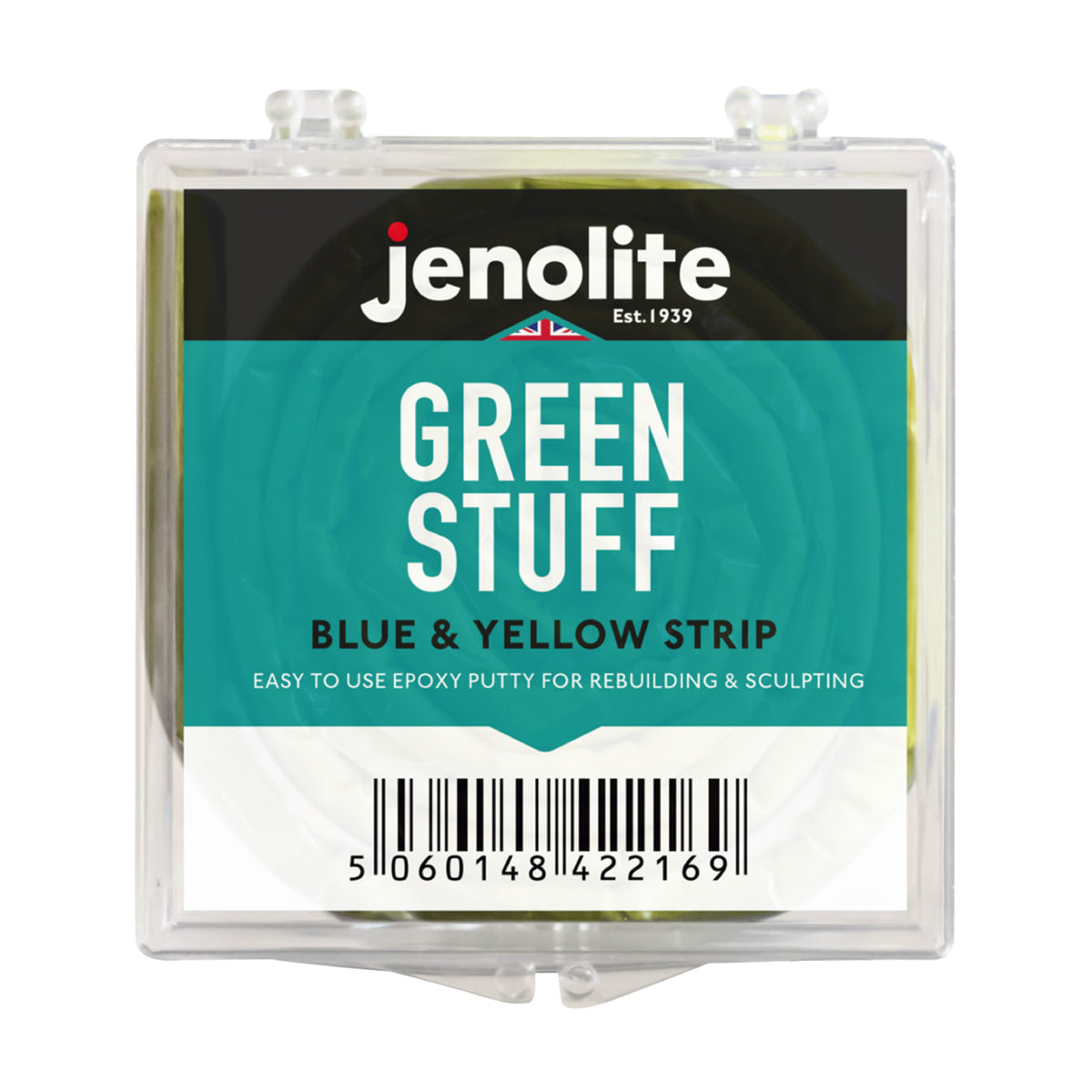
Description (Green Stuff Epoxy Putty Roll | Blue & Yellow Strip | 36 Inch):
-
STRONG ADHESIVE PUTTY: JENOLITE Green Stuff Epoxy Putty Roll is a two-part epoxy putty for sculpting, gap filling and small repairs. The blue and yellow strip kneads into a strong, mouldable green putty that hardens into a durable finish.
-
SCULPTING & MODELING: Formulated as a sculptor’s epoxy putty, Green Stuff is used to build miniature models and parts from scratch, or to repair and modify existing pieces. It holds fine lines and shapes for detailed work.
-
DIY REPAIRS: Bonds well to stone, ceramic, metal, wood and many plastics, including vinyl, so it suits small household and hobby repairs as well as model making.
-
EPOXY SCULPTING PUTTY: Cut only the length you need to limit waste, then hand-mix and sculpt it to shape. Once fully cured it can be glued, sanded, filed, cut and painted.
-
USED BY: Tabletop gamers use Green Stuff to adapt and create miniature models. It is a popular modelling putty for Warhammer and other miniature gaming formats where fine detail matters.
Discover Also:
2. Milliput Standard Epoxy Putty

Milliput Standard is the yellow and grey two-part putty from The Milliput Company in Dolgellau, Wales. The grade dates from 1968 and is still the one many workshops reach for when a repair needs shaping rather than a rush plug. Equal lengths of the two sticks are cut and kneaded until the colour is even. At normal room temperature the mix stays soft for about one and a half to two hours, then sets hard in about three to four hours and keeps curing after that. Heat can shorten the set. Once hard it can be carved, filed, drilled, tapped, sanded and painted. It bonds to wood, brick, cement, metals, concrete, many plastics and glass, and it will set underwater. Continuous heat resistance sits around 130°C, with a short peak a little higher. It is an excellent packed filler for tanks, radiators, model gaps and chipped castings. It is not a thin-film glue, so a hairline joint is the wrong job. The mineral filler is coarser than a fine white grade, and that can show if the face must be glass-smooth. Cold putty is stiff to knead. Warm it in the hands first, and mix only what the open time will let you place.
Key Features
-
Yellow and grey sticks, mixed one to one.
-
Long work time for shaped and underwater repairs.
-
Can be machined, sanded and painted after cure.
-
Bonds to metal, wood, masonry, glass and many plastics.
Facts and Information
-
Made in Dolgellau, Wales, since the late 1960s.
-
Sets in about three to four hours at room temperature.
-
Heat resistance around 130°C in continuous use.
-
Better as a packed fill than as a thin adhesive.
3. Milliput Superfine White Epoxy Putty 
Milliput Superfine White comes from the same Dolgellau maker and is the smoother grade for fine gaps, ceramic chips and model work. Equal parts mix to a pale putty. The open time matches the standard grade, so there is room to fair an edge or fill a small chip without the mix going off in the hand. It hardens over several hours and can then be carved, sanded and painted. The finer filler leaves a cleaner face than the yellow and grey standard, which is why restorers use it on porcelain, figurines and pale plastics. Adhesion covers ceramics, metal, wood and many hard plastics. Heat resistance sits in the same band as the other Milliput grades, around 130°C. The slow set is a real limit on a running leak. It also has less body for a heavy rebuild on thick steel, where a metal-filled stick carries more bulk. It is not meant as a drinking-water seal unless a specific approval is stated. For a visible chip that will be painted or left pale, the fine grade earns its place. For a midnight pipe drip, a fast steel or copper stick is the closer tool.
Key Features
-
Fine white filler for a smoother cured face.
-
Same one-to-one mix and long work time as other Milliput grades.
-
Sands, carves and takes paint after it has set.
-
Useful on ceramics, pale plastics and fine model gaps.
Facts and Information
-
Produced in Dolgellau, Wales.
-
Full hardness takes longer than a fast metal stick.
-
Heat band around 130°C.
-
Better for detail than for a thick structural plug.
4. Milliput Terracotta Epoxy Putty
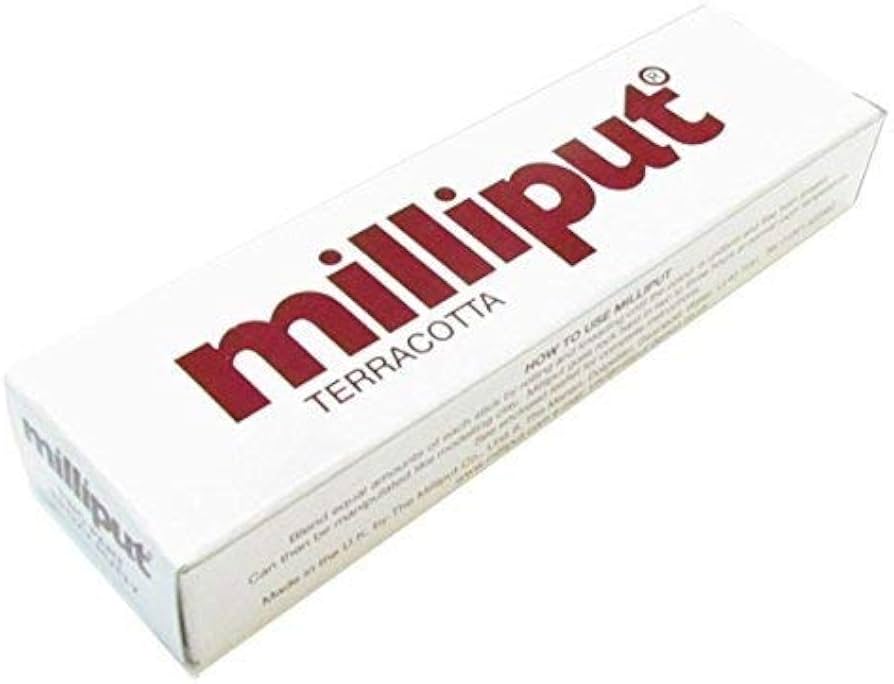
Milliput Terracotta is the ceramic-coloured grade from Dolgellau, worked like modelling clay and aimed at pots, stoneware and masonry. Equal lengths are kneaded to an even warm tone, then pressed into chips, cracks and missing rims. Work time is long. At normal room temperature it sets over three to four hours, then can be sanded or painted if the colour is not quite right. Adhesion covers ceramics, stone, wood and metal, so a chipped planter or a damaged quarry tile can be rebuilt rather than thrown out. The colour is the point. A grey metal stick looks wrong on clay. On bright white sanitary ware the warm shade can look off, so a white fine grade is the better match there. It is not steel-filled and it is not a fast emergency plug. Hot pipework and pressurised supply lines are outside its best use. Garden pots, fireplace slips and small masonry patches suit it well, as long as loose dust is brushed off and the piece is supported while the putty cures.
Key Features
-
Terracotta shade for pots, stoneware and masonry.
-
Long open time for shaping rims and chips.
-
Bonds to ceramics, stone, wood and metal.
-
Can be sanded and painted after cure.
Facts and Information
-
Made by The Milliput Company in Dolgellau.
-
Sets in about three to four hours at room temperature.
-
Colour match beats a grey stick on clay.
-
Weak choice for a hot or high-pressure metal joint.
5. Sylmasta Superfast Steel Epoxy Putty
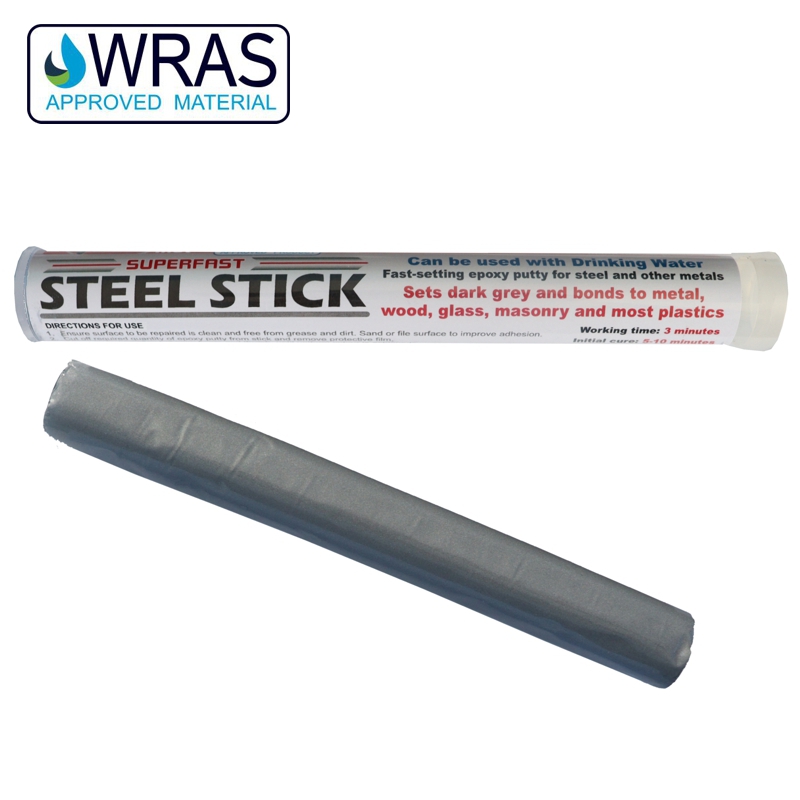
Sylmasta Superfast Steel is a steel-filled stick made at Sylmasta’s site in Scaynes Hill, West Sussex. The firm builds its own sticks in the UK, which means trade buyers can get fresh stock rather than a stick that has sat in a container. Work time is short, around four to five minutes, and functional cure is often about an hour. Service temperature is quoted up to about 150°C. This grade carries WRAS approval for drinking-water contact, which matters on cold tanks and potable pipe where a general stick must not be used. It bonds to steel and other metals and can be drilled, tapped and machined after cure. The short open time is a strength on a small leak and a limit on a large, fiddly shape. Knead fully, then place at once. A half-mixed core will stay soft under a hard skin. It is a maintenance stick, not a modelling putty. For a cracked steel bracket, a holed tank wall or a plant-room fitting, it is a direct UK-made match.
Key Features
-
Steel-filled fast stick made in West Sussex.
-
WRAS approval on this grade for drinking water.
-
Machinable after cure.
-
Short work time for small metal leaks.
Facts and Information
-
Functional strength in about an hour.
-
Heat service up to about 150°C.
-
Produced at Scaynes Hill, including larger diameter sticks.
-
Speed helps a drip and hinders a slow sculpt.
6. Sylmasta Superfast Copper Epoxy Putty 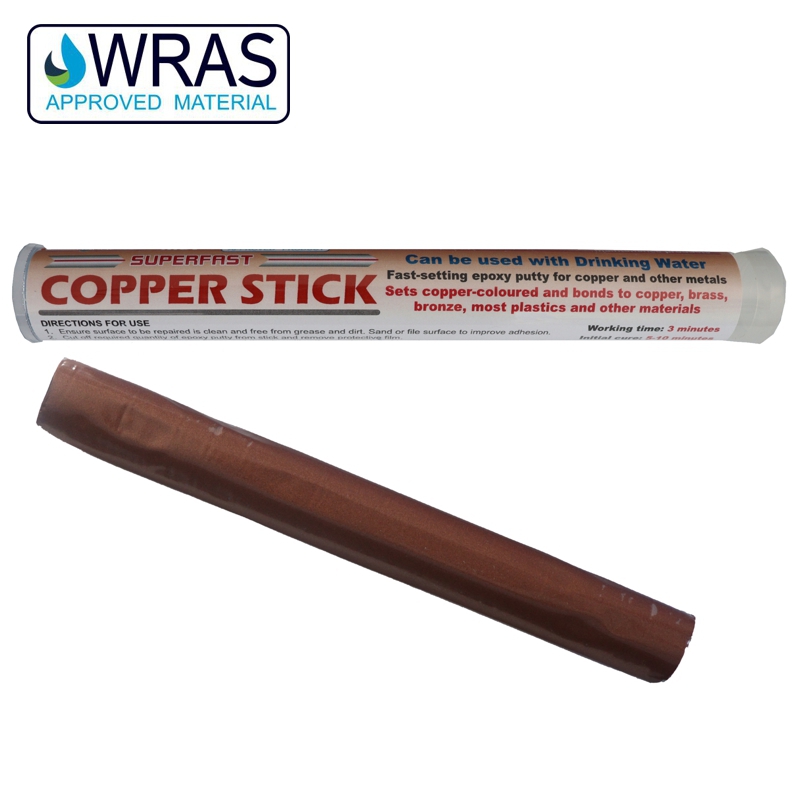
Sylmasta Superfast Copper is the copper-filled stick from the same West Sussex factory, aimed at brass, copper and bronze. Elbows, taps, hot lines and cylinder fittings are the usual jobs. A steel stick can hold on those metals, but the copper filler is the closer match for bond and colour. Work time is short, in the same fast band as the steel grade, so the piece must be kneaded and pressed without a long pause. After cure it can be filed and painted if the repair will show. It is a maintenance product rather than a modelling putty, so fine sculpting is not its best use. Heat and water resistance suit plumbing repairs on sound metal. On polythene or PEX it will not bite, which is true of most epoxy sticks. Clean green corrosion back to bright metal before you mix. A film of flux or grease will leave a plug that looks stuck and then weeps. For a copper tank patch or a weeping brass fitting, it is the specialist stick in this UK range.
Key Features
-
Copper filler for non-ferrous pipe and fittings.
-
Short work time for leak repairs.
-
Can be filed and overpainted.
-
Made for brass, copper and bronze.
Facts and Information
-
Made in Scaynes Hill with the rest of the Superfast range.
-
Better on copper and brass than on plastic pipe.
-
Speed suits a small joint, not a slow rebuild.
-
Surface must be bright and free of grease.
7. Sylmasta Superfast Aluminium Epoxy Putty
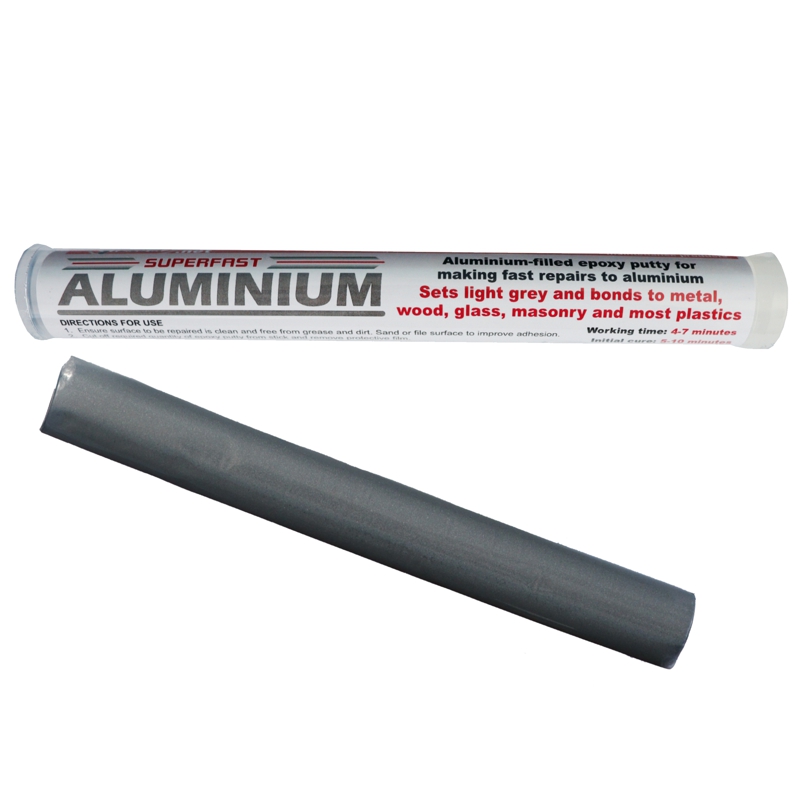
Sylmasta Superfast Aluminium is an aluminium-filled stick from Scaynes Hill for castings, window frames, boat fittings and alloy housings. The metal filler helps the repair blend with aluminium better than a dark steel stick, and it can be machined back once hard. Cure is fast, in the same Superfast band as the steel grade, so a large fairing needs a plan before the stick is cut. It bonds to clean alloy and can be painted after cure. It is not the automatic choice for a drinking-water joint unless that exact stick carries the approval. Oily, unprepared alloy is the usual failure. Degrease, abrade, and keep skin oils off the face. Thin cracked castings still need support. The putty replaces missing metal at a chip or hole. It does not stitch a part that flexes every time a cover is bolted down. For a chipped aluminium frame, a holed gearbox lug or a boat fitting, it is a sensible specialist stick from a UK factory.
Key Features
-
Aluminium filler for alloy parts and frames.
-
Fast set in the Superfast band.
-
Can be machined and painted.
-
Better colour match on aluminium than a steel stick.
Facts and Information
-
Produced in West Sussex.
-
Large areas need sectioning because the open time is short.
-
Surface must be clean and de-greased.
-
Not a substitute for a cracked safety-critical casting.
8. Sylmasta Superfast Aqua PW Epoxy Putty
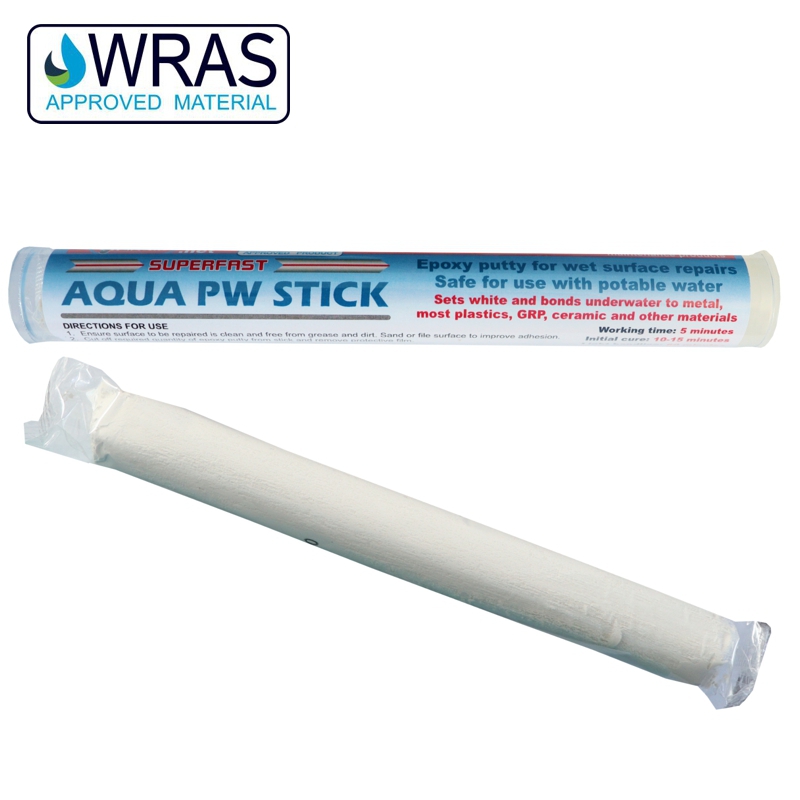
Sylmasta Superfast Aqua PW is the wet-surface stick from Scaynes Hill with WRAS approval for drinking water. It is built to bond where the face is damp, which is the usual state of a leaking pipe, a tank seam or a sump fitting. Work time is short. Functional strength arrives on a similar fast timetable to the other Superfast sticks, often around an hour for a working repair. The grade has also been used with pipe bandages on repairs checked against recognised leak-repair guidance. That does not make a plug a new pipe. It does mean the stick is taken seriously on wet plant work. It is less handy for dry cosmetic model work, where a longer open time helps. Even on a wet-rated stick, wipe away loose slime and standing water if you can, then hold the putty until it grabs. For a damp joint in a plant room, or a cold-water tank that cannot be dried, it is one of the more relevant UK-made sticks.
Key Features
-
Made for damp and wet faces.
-
WRAS approval for drinking-water contact.
-
Fast cure for plant-room leaks.
-
Can be used with a pipe bandage on checked repairs.
Facts and Information
-
Manufactured in the UK at Scaynes Hill.
-
Short open time, so mix only what you can place.
-
Better on a live damp joint than on fine dry sculpting.
-
Still needs firm material under the plug.
9. Sylmasta AB Original Epoxy Putty 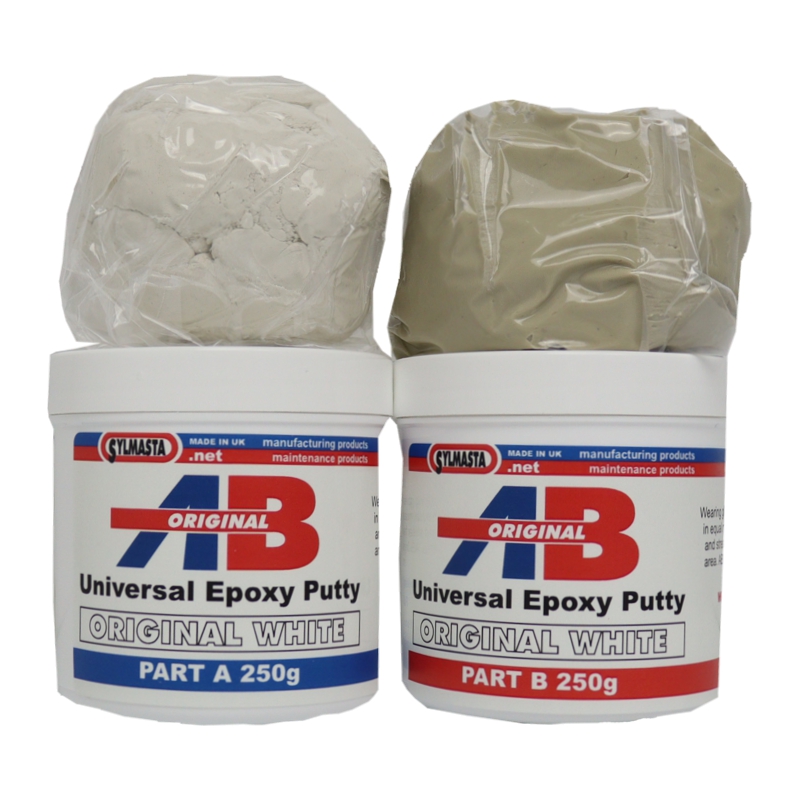
Sylmasta AB Original is the firm’s older ceramic-filled putty, still made in West Sussex, with a much longer work time than the Superfast sticks. The general-purpose version stays workable for around two hours, which helps on beams, large voids and shaped repairs where a four-minute stick would skin over. The ceramic fill makes it harder wearing than a soft filler. It is kneaded and pressed in by hand, then left to cure. Trade users like it for wood rot pockets and rebuilt edges where speed is not the goal. It can be pushed into soft timber, then topped with a hardwood insert once the putty has a hold. It is slower for an emergency drip. A running pipe wants a Superfast grade. AB Original wants a job you can support and leave. Fresh UK production and small-batch supply suit workshops that do not want a crate of ageing sticks. It is a rebuild putty, not a thin glue and not a gas-pipe seal.
Key Features
-
Ceramic-filled putty kneaded by hand.
-
Long work time for complex shapes and large voids.
-
Harder wearing than a soft stopper.
-
Used on timber pockets as well as hard surfaces.
Facts and Information
-
Made in Scaynes Hill, West Sussex.
-
Open time around two hours on the general-purpose version.
-
Better for large voids than for a sudden drip.
-
Can be paired with timber inserts on rotten beams.
10. Evo-Stik Hard And Fast Metal Epoxy Putty
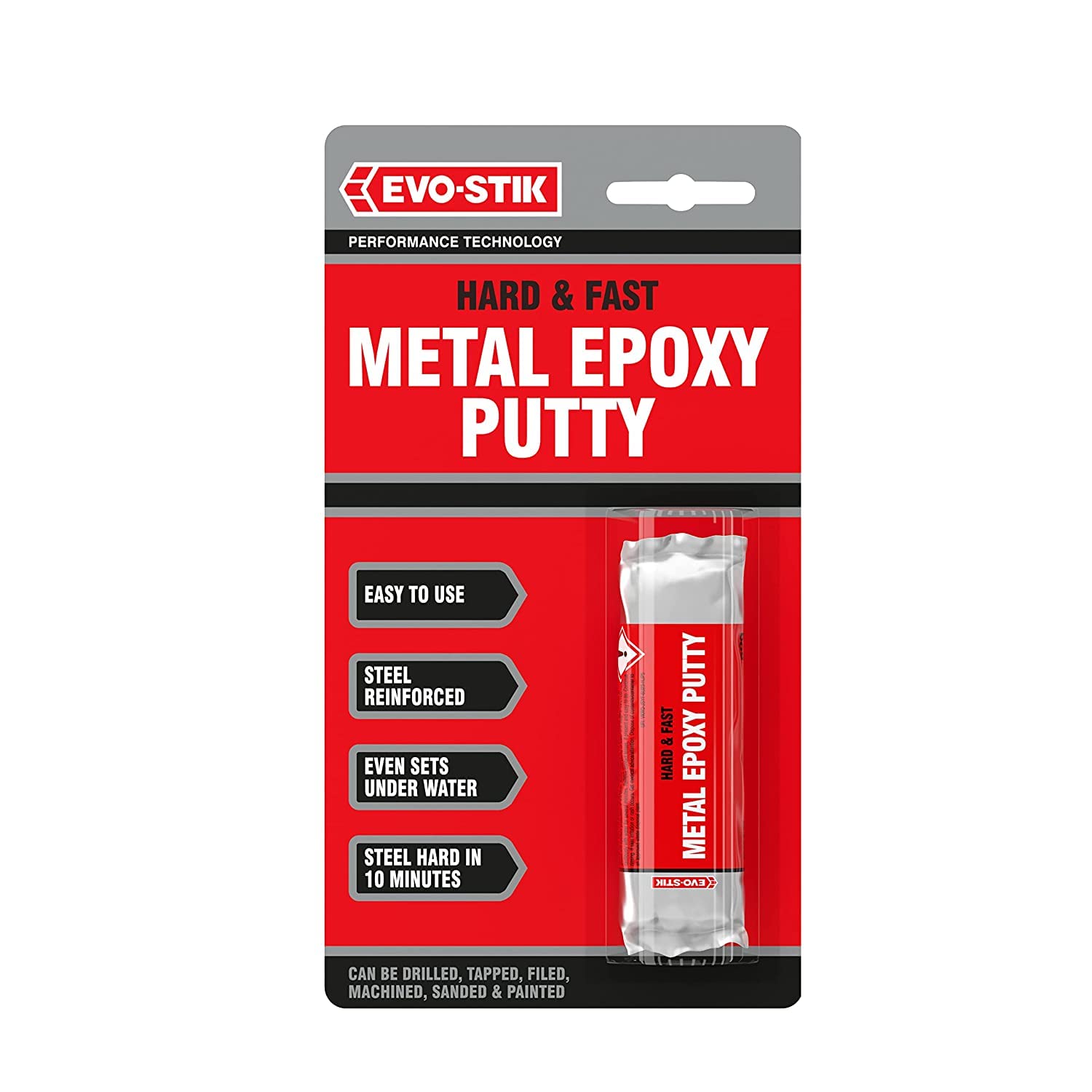
Evo-Stik Hard and Fast Metal Epoxy Putty is a steel-reinforced stick from the long-running UK brand, sold for home and light trade repairs. The 50g stick sets to a steel-hard grey in about five to ten minutes and reaches full cure in about 30 to 60 minutes. It can be used underwater and bonds to metal, glass, many plastics, wood and dry concrete. After cure it can be drilled, tapped, filed, machined, sanded and painted. That speed is the selling point on a single weep under a sink or a chipped cast bracket in a shed. The small stick is handy for one leak and light for a big rebuild. Very short work time punishes slow hands. Knead until the colour is even, then press at once and hold the shape. It is a high-street classic rather than a specialist range with separate copper, titanium and plastic grades. On a copper pipe it will bond if the face is clean, but a copper-filled stick is the closer match. On polythene it will not hold.
Key Features
-
Steel-reinforced stick that cures grey.
-
Sets hard in about 10 minutes and can be used underwater.
-
Drills, taps, files and paints after cure.
-
Bonds to metal, glass, wood, dry concrete and many plastics.
Facts and Information
-
Full cure often inside an hour.
-
Small 50g stick suits one repair better than a long crack.
-
Short work time leaves little room to reshape.
-
A general metal stick, not a multi-grade specialist set.
11. Belzona 1111 Super Metal

Belzona 1111 Super Metal is a two-part epoxy paste from Belzona in Harrogate, built for industrial metal rebuilds rather than a pocket stick. Base and solidifier are measured, then mixed to a paste with a working life of about 15 minutes at 25°C. At room temperature a layer around 6mm thick can take light loading in a couple of hours and full mechanical load in about a day. Thicker sections cure faster. Thinner ones take longer. It resists slump on vertical faces and is used on shafts, casings, worn housings and pitted metal. After cure it can be machined back to a working face. Post-curing with heat can raise the mechanical and chemical performance, which is a workshop step, not a kitchen-sink one. It is awkward for a tiny home drip, and the mix ratio must be right. A short measure leaves a soft patch. For a maintenance shop that already rebuilds machinery, it is a serious metal paste. For a single weeping elbow, a pre-measured stick is the simpler tool.
Key Features
-
Measured paste, not a pre-formed stick.
-
High build with no slump on vertical metal.
-
Can be machined after cure.
-
Used on shafts, casings and worn industrial parts.
Facts and Information
-
Made by Belzona in Harrogate.
-
Working life about 15 minutes at 25°C.
-
Full mechanical load often needs about a day at room temperature.
-
Mix ratio matters more than with a cut-and-knead stick.
12. Milliput Silver Grey Epoxy Putty
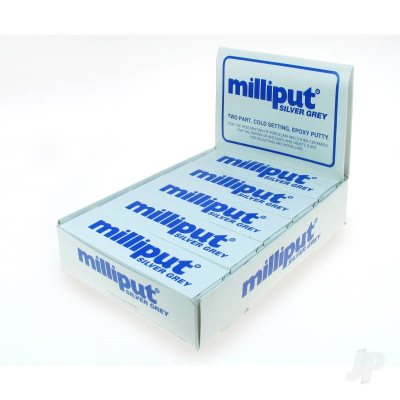
Milliput Silver Grey is the metal-toned grade from The Milliput Company in Dolgellau. It uses the same one-to-one mix as the standard putty, with a long work time and a hard set over three to four hours at room temperature. The silver-grey colour is the reason to pick it. Model makers, prop builders and light metal repairs use it where a yellow-grey mix would need heavy paint to disappear. Once cured it can be filed, drilled, sanded and painted, and it bonds to metals, wood, masonry, glass and many plastics. It will set underwater, in the same way as the other Milliput grades, and heat resistance sits around 130°C. It is still a mineral-filled putty, not a steel-loaded emergency stick. A fast leak on a hot pipe is better served by a short-work-time metal grade. The long open time is the advantage on a fairing, a casting chip or a model seam that must be smoothed before it firms. Cold stock needs warming in the hands or it crumbles instead of blending.
Key Features
-
Silver-grey colour for metal-looking fills.
-
Long work time and a hard, machinable cure.
-
Bonds to metal, wood, glass and many plastics.
-
Can be sanded and painted after set.
Facts and Information
-
Made in Dolgellau, Wales.
-
Sets in about three to four hours at room temperature.
-
Heat band around 130°C.
-
Better for appearance and shaping than for a sudden drip.
13. Sylmasta Superfast Plastic Epoxy Putty
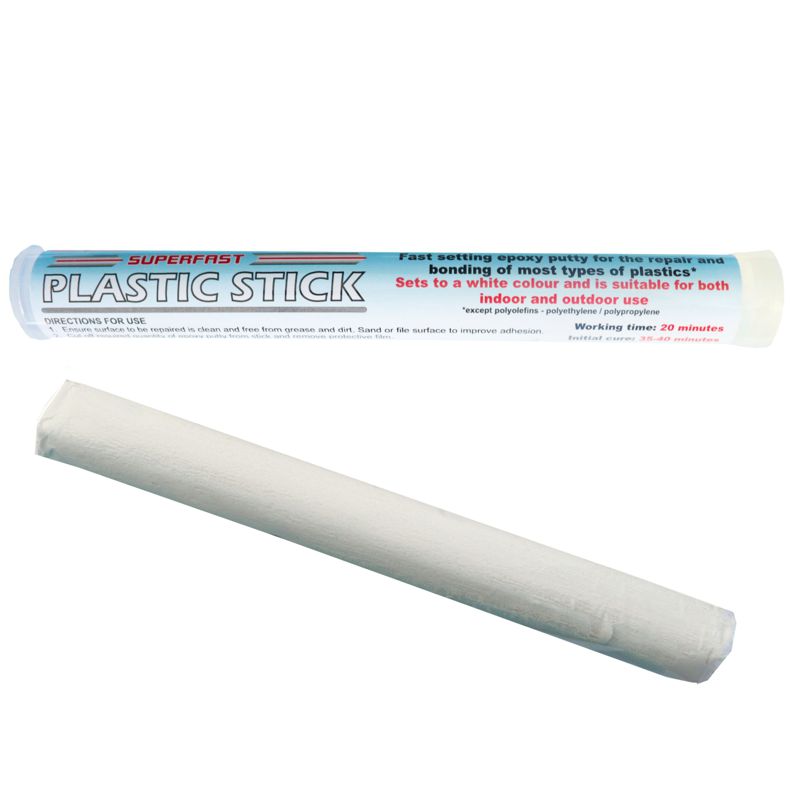
Sylmasta Superfast Plastic is the plastic-filled stick from the Scaynes Hill factory, for rigid and semi-flexible plastics other than polyolefins. It sets white, which suits PVC and ABS waste pipe better than a dark steel stick. Work time is longer than the steel grade, around 20 minutes, so a collar around a cracked fitting can be shaped before it firms. It is still a repair stick, not a modelling clay. Polythene, polypropylene and PEX remain poor matches because the face is too slick for a reliable bond. Roughen the shine, clean off soap film, and press the putty past the crack onto sound plastic. Once cured it can be sanded and painted. It will not replace a split soil pipe that has lost a long section, and it is not a thread seal for a pressurised supply. For a cracked waste fitting, a chipped rigid plastic housing or a small hole in a cold-water cistern lid, it is the UK-made grade aimed at the plastic itself.
Key Features
-
Plastic-filled stick that sets white.
-
About 20 minutes of work time.
-
Bonds to many rigid plastics, not polyolefins.
-
Can be sanded and painted after cure.
Facts and Information
-
Manufactured in West Sussex.
-
Better on PVC and ABS than on PEX or polythene.
-
Longer open time than the Superfast steel grade.
-
A local crack repair, not a new length of pipe.
Which UK Pipes Epoxy Putty Can Seal
UK homes still run a mix of old and new pipe. Copper and brass supply lines, galvanised steel in older houses, cast iron soil stacks, and PVC or ABS waste pipes all take a metal or plastic stick if the face is sound. A copper-filled stick is the closer match on brass and copper. A steel stick suits galvanised and cast iron. A plastic stick suits rigid waste pipe.
It does not bond well to polyethylene or to PEX. Those plastics have a slick, low-energy face. A push-fit coupling is the right fix there, not a kneaded plug. The same limit shows up on some flexible pond liners and thin polythene tanks.
Small holes, hairline cracks and chipped fittings are the jobs a stick can hold. A burst rising main, a long rotten galvanised run, or a joint you cannot reach are not. Gas pipe is never an epoxy job. If the leak is on a supply you cannot isolate, a plumber is the safer call rather than packing putty into running water.
|
Pipe |
Stick That Fits |
Limit |
|
Copper or brass |
Copper-filled putty |
Dry the face if you can |
|
Galvanised or cast iron |
Steel-filled putty |
Knock off loose rust first |
|
PVC or ABS waste |
Plastic grade |
Roughen the shine |
|
Damp tank or sump |
Underwater grade |
Hold until it grabs |
|
PEX or polyethylene |
Not a putty job |
Use a push-fit fitting |
A metal epoxy putty stick matched to the metal is the closer choice on copper, steel and aluminium pipe than one general lump.
Epoxy Putty For UK Homes And Workshops
British houses throw up the same small failures every winter. A copper elbow weeps. A cast gutter cracks. An aluminium window corner chips. A water butt splits. A repair products shelf that already holds a metal stick and a wet-grade stick covers most of those calls.
Boats and garden water are the other UK pattern. Decks, hull chips, pool fittings and cold tanks stay damp. A stick that only likes a dry bench will fail there. Match the underwater or wet-surface grade, press out the water as you pack the hole, and hold the shape until it grabs.
Workshops and garages see a different mix. Alloy casings, steel brackets and plastic covers all turn up. A metal putty stick can rebuild a chipped edge so a part goes back into service. It will not replace a cracked safety-critical casting. If the part carries people, pressure or brakes, a new part is the sound choice.
Epoxy Putty Or Liquid Epoxy For Pipe Repairs
For a leak on a round pipe, a stick beats a liquid epoxy almost every time. Liquid resin needs a measured mix. It drips off a vertical pipe and runs away from the hole. It also wants an oil-free, dry face. A stick is already in the right share. Cut, knead, press. It stays where you put it and wraps a curve under a sink or behind a bath panel.
Liquid epoxy still has a place. A flat crack in a casing, a thread that needs a thin bond, or a job that must soak into a fine gap can suit a syringe resin better than a lump of putty. Putty is a poor thin-film glue. If the joint needs a paste you can spread like adhesive, a stick is the wrong format.
Under a kitchen sink the format matters as much as the formula. You are often on your back, with one hand free. A pre-measured epoxy putty repair stick is faster and cleaner there than pots, hardener and a mixing board you cannot balance.
Surface Prep That Makes The Bond Hold
Putty sticks to clean, sound material. It does not stick to loose rust, oil, flaking paint or green slime. Wire-brush or scrape back to firm metal. Wash off dust. Dry the face unless the stick is rated for wet use.
On rusty steel, a rust treatment step before the fill stops the corrosion sitting under the patch. A rust converter epoxy aerosol turns remaining rust into a stable coat on areas that will be painted, which is a different job from packing a hole. The converter treats the corroded face. The putty fills the missing metal.
Roughen smooth plastic and bare aluminium with a fine abrasive so the putty has a key. Do not trap water behind the plug on a dry-only grade. Warm a cold stick in the hands before kneading, or it will fight you. Mix only what you can place inside the work time. Unused stick, still in its wrap, keeps for a long time.
After cure, sand, then coat. Bare epoxy will chalk outdoors. A matching paint or primer locks the repair and hides the patch. On cars and bikes, the same order applies: clean metal, fill, then a finish from the motor care range if the part lives on the vehicle.
When A Stick Beats A New Part
A stick wins when the damage is local, the part is sound around it, and the face can be reached. Plug a hole. Rebuild a chipped corner. Seal a weep on a fitting that cannot be replaced tonight. Shape a missing lug, then drill it once hard.
A stick loses when the section is gone over a wide span, the joint moves all the time, or the part is safety-critical. It is also the wrong tool for polyethylene pipe, oily contamination that cannot be removed, and any repair sold as food-contact unless the grade says so. Jenolite sticks are not certified for drinking water or direct food contact. Where that approval matters, a grade that carries it is the one to use.
Sculpting and gap filling sit in a third group. A roll such as Green Stuff epoxy putty is cut to length, mixed from the blue and yellow strip, and shaped for models and small DIY gaps. It is slower to full hardness than a repair stick, and that is the point. Repair sticks are for holding water and rebuilding edges. Modelling putty is for form.
Frequently Asked Questions
Can Epoxy Putty Stop A Live Leak?
Yes, if the grade is made for wet or underwater use and it can be pressed into firm material. Drop the pressure first where a valve allows it, then knead fast and hold the plug until it grabs. A dry-only stick on a running leak will wash out before it can bond. Large pressure leaks still need a proper pipe repair, not a plug alone. An underwater epoxy putty is the grade made for fresh or salt water on hulls, tanks and gutters.
Is Epoxy Putty The Same As Plumbers Putty?
No. Plumbers putty is a soft, oily bedding compound for strains and wastes, and it stays soft. Epoxy putty cures hard, can be drilled, and is meant to stay in the repair. People search both names for a leaking fitting, but the products do different work. Epoxy putty rebuilds a missing edge and seals a packed hole. Plumbers putty only belongs where a soft bed is specified. A metal epoxy putty stick is the closer match for a copper or steel pipe than a tub of soft bedding compound.
Can You Paint Over Epoxy Putty?
Yes, after it has cured. Sand the shine off, wipe the dust, then prime and paint. Metal repairs that will sit outside last longer under a coating than as bare epoxy, which can chalk in the weather. Match the paint to the part, whether that is a radiator, a gate or a hull. Painting too soon can trap soft resin and wrinkle the finish. A cured fill takes a paint or primer once the surface is hard and dust-free.
Does Epoxy Putty Work On PVC Waste Pipe?
Yes, on rigid PVC and ABS, if the pipe is clean and the shine is taken off with a fine abrasive. Keep the pipe dry unless the stick is rated for wet faces. Plastic waste and drain lines are a common home use, and a well packed repair there can last a long time because the line is not on mains pressure. PEX and polyethylene are the plastics to leave alone, because the face is too slick for a reliable bond. A plastic grade in the epoxy putty repair sticks range is aimed at rigid and semi-flexible plastics rather than a steel fill.
How Long Does Epoxy Putty Take To Harden?
Fast metal sticks often feel firm in about 20 to 60 minutes and reach a working strength around the hour mark. Thicker lumps and cold rooms take longer. A long-open putty can stay soft for more than an hour, then harden over several hours, which suits shaping more than a live drip. Water should stay off until the repair is rigid. Full cure is not the same as the first firm set, so a joint that will be drilled or put back under pressure needs the longer wait. Epoxy putty sticks are at their best once that cure is complete and the fill can be sanded or machined.
Read Also:
Discover the Best Epoxy Putty in 2026 - Jenolite.



