
Best Epoxy Putty Stick in 2026

A cracked pipe, chipped steel edge, or split plastic housing does not always need a new part. The best epoxy putty stick in 2026 is a hand-mixed stick that bonds, fills, and cures into a hard, sandable repair. Jenolite epoxy putty sticks cover steel, copper, aluminium, titanium, plastic and underwater jobs from one British range.
Epoxy putty sticks are part of a wider range of repair compounds, with different formulations suited to particular materials and applications. The guide to the best epoxy putty covers versatile repair options, while the guide to the best metal epoxy putty focuses on compounds developed for durable metal repairs.
Discover the Best Epoxy Putty Stick in 2026 - Jenolite.
What Is An Epoxy Putty Stick In The UK

The best epoxy putty stick in 2026 is a repair filler with resin and hardener already packed in one tube, usually as a core inside an outer layer. Cut a piece, knead it, and the two parts meet in the right ratio. No scales, no cups, no guesswork.
In UK homes, it is used on holes, chips and worn edges in metal, plastic, wood, ceramic and masonry. Furniture pulls, appliance housings, car brackets, model gaps and small pipe leaks all sit in that group. The stick is portable, so it lives in a toolbox rather than on a workshop bench.
Once mixed it is a soft, shapeable mass. Press it in, strike it smooth, and it hardens into a durable bond with water resistance and, on the right formula, useful heat resistance. After cure it can be sanded, drilled, tapped, and painted. It is a filler that also bonds, not a thin glue and not a load-bearing weld.
Specialty sticks beat a generic mix. A steel-filled stick grips ferrous metal. A copper stick suits brass and bronze. An underwater stick holds on a wet surface where a dry-only mix lets go. That split is why a matched epoxy putty stick is the safer buy for a known job. Jenolite (UK) Ltd in Biggleswade supplies steel, copper, aluminium, titanium, plastic and underwater sticks in that British range.
How An Epoxy Putty Stick Works
The cure starts when resin and hardener are fully blended. Streaks of the original colours mean the mix is not finished, and those streaks stay weak. An even colour is the sign to stop kneading and start placing.
Push the putty into the damage, not just over it. A skin across a crack looks tidy and fails when the part flexes or the pipe sees pressure. Overlap the sound material around the hole so the patch has a rim to lock onto.
Fast sticks firm in minutes. Slower sticks stay soft long enough to shape a corner or a deep fill. Heat from the reaction, plus room temperature, sets the pace. A cold garage slows everything. Warm hands speed the mix.
Metal epoxy putty follows the same knead-and-press method, with the filler changed to suit steel, copper, aluminium or titanium. The repair and seal range also includes leak sealers for gutters and flat roofs when the damage is a seam rather than a hole you can pack.
How To Use An Epoxy Putty Stick
A clean, keyed surface matters more than a heavy blob of putty.
-
Cut or twist off only what the repair needs. Cap the rest at once.
-
Knead with gloved fingers until the colour is one even shade, with no streaks.
-
Force the soft putty into the crack or hole within the work time. On fast sticks that can be a couple of minutes.
-
Overlap the sound edge. Smooth with a damp finger or a wet tool.
-
Hold a wet repair in place until it grabs. Leave thin layers to harden before you build more.
-
Wait for functional strength before light use, and for a full cure before hard sanding or paint.
Warm a stiff stick in your hands if it will not blend. Do not bake it. Polyethylene and polypropylene often refuse a bond, so test those plastics on a scrap first. Wood should not be soaking wet, or the board can move and open a line at the fill. The method for filling holes in wood with epoxy is the same cut, knead and pack, with a damp tool to strike off the excess.
On steel, loose rust under the patch will keep creeping. A rust treatment step before the stick goes on gives the putty a sound surface to grip. Most Jenolite sticks are ready for light use in about 60 minutes, with thin layers reaching full cure in about 4 to 6 hours.
Best Epoxy Putty Stick in 2026
1. Jenolite Epoxy Putty Repair Stick - Best Epoxy Putty Stick in 2026
The Jenolite epoxy putty stick is a hand-mixed repair compound made in Britain and sold by Jenolite (UK) Ltd in Biggleswade, Bedfordshire. Each tube is 112g and about 7 inches long. Cut off what the job needs, knead to one even colour, then press it into a crack, hole or worn edge. Six sticks cover the jobs people actually meet: steel, copper, aluminium, titanium, plastic and underwater. A stick built for one metal grips that surface more tightly than a one-mix-fits-all putty. The underwater stick goes on damp or submerged repairs in fresh or salt water, which suits a leaking tank, boat fitting or wet pipe. Most sticks are ready for light use in about 60 minutes, with thin layers reaching full cure in about 4 to 6 hours. Once hard, the patch is waterproof and can be sanded, sawn, drilled, tapped and painted. The titanium stick is the heat choice, rated up to 280°C. The steel stick is rated up to 149°C. Kept sealed, unused putty stays workable for about two years.
Epoxy Putty Repair Sticks | 7 Inch (112g) Tube | Plastic, Steel, Underwater, Copper, Aluminium, Titanium 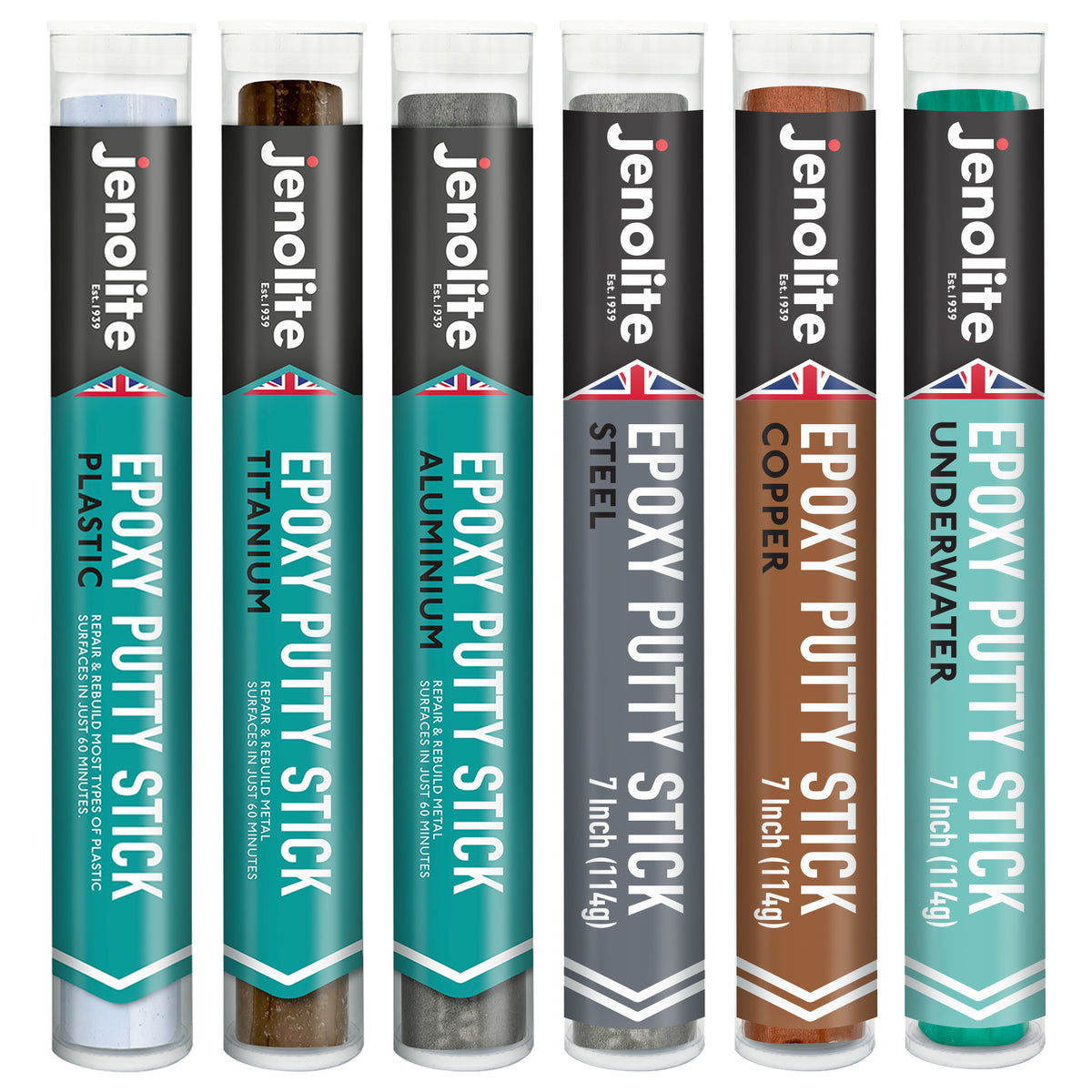
Description (Epoxy Putty Repair Sticks | 7 Inch (112g) Tube | Plastic, Steel, Underwater, Copper, Aluminium, Titanium):
-
HAND MIX & APPLY: JENOLITE Epoxy Putty Sticks are two-part epoxy repair sticks that you knead by hand, then press into place to rebuild, fill and bond damaged parts.
-
MULTI-SURFACE APPLICATIONS: Each stick is made for a specific substrate, covering metal, steel, aluminium, copper, titanium, plastic, fibreglass, ceramics and similar materials.
-
WEATHER PROOF & RESISTANT TO CORROSION: Suitable indoors and outdoors. The cured epoxy putty resists water, chemicals and temperature extremes.
-
FAST ACTING: Usable within minutes and typically fully functional in 60 minutes. Check the technical data sheet for exact cure times by variant.
-
DURABLE: Hand-mix the two parts into a polymer compound, then mould, wrap or build it up to join and repair components. Once fully cured it is waterproof and can be sanded, sawn, drilled and painted.
-
PLASTIC EPOXY PUTTY: A two-component stick for repairing and rebuilding most major plastic types. After mixing, the fast-setting epoxy bonds to rigid and semi-flexible plastic and can be moulded, wrapped or built up to restore the damaged area.
-
TITANIUM EPOXY PUTTY: A non-rusting, titanium-reinforced epoxy for cracked, snapped or holed metal. Industrial-strength and rated for high-temperature use up to 260°C. Functional after 60 minutes. Once fully cured it is waterproof and can be drilled, tapped, machined, ground, filed and painted.
-
ALUMINIUM EPOXY PUTTY: A non-rusting, aluminium-reinforced epoxy for scratched, chipped or cracked metal. Mix by hand and apply straight to the repair. Once fully cured it can be drilled, tapped, machined, ground, filed and painted. A practical workshop repair stick for mechanics.
-
STEEL EPOXY PUTTY: A non-rusting, steel-reinforced epoxy for rebuilding and repairing metal. Mix by hand and press onto scratched, chipped or cracked areas. Industrial-strength, withstands temperatures up to 149°C, and is functional after 60 minutes. Once fully cured it is waterproof and can be drilled, tapped, machined, ground, filed and painted.
-
COPPER EPOXY PUTTY: A two-component stick for pipes, tanks, hot lines and vessels in brass, copper, bronze and other non-ferrous metals. Use it on plumbing elbows, sinks, taps and water heaters, and to seal freeze breaks. Hand-mix, mould to the joint, and once fully cured it is waterproof and can be sanded and painted. A plumber’s epoxy for leaking hot pipework.
-
UNDERWATER EPOXY PUTTY: A hand-mixable epoxy for damp, wet and submerged repairs in fresh or salt water. Bonds to fibreglass, concrete and similar substrates. Suited to marine decks and hulls, swimming pools, hot tubs, spas, recreational equipment, and leaking tanks and gutters. Functional after 60 minutes. Once fully cured it is waterproof and can be drilled, tapped, machined, ground, filed and painted.
-
MADE IN THE UK
-
Please note: Packaging may differ from the images shown because of label updates. Contents and quality are unchanged.
Discover a Jenolite epoxy putty stick.
Discover Also:
2. Superfast Steel Epoxy Putty Stick Sylmasta
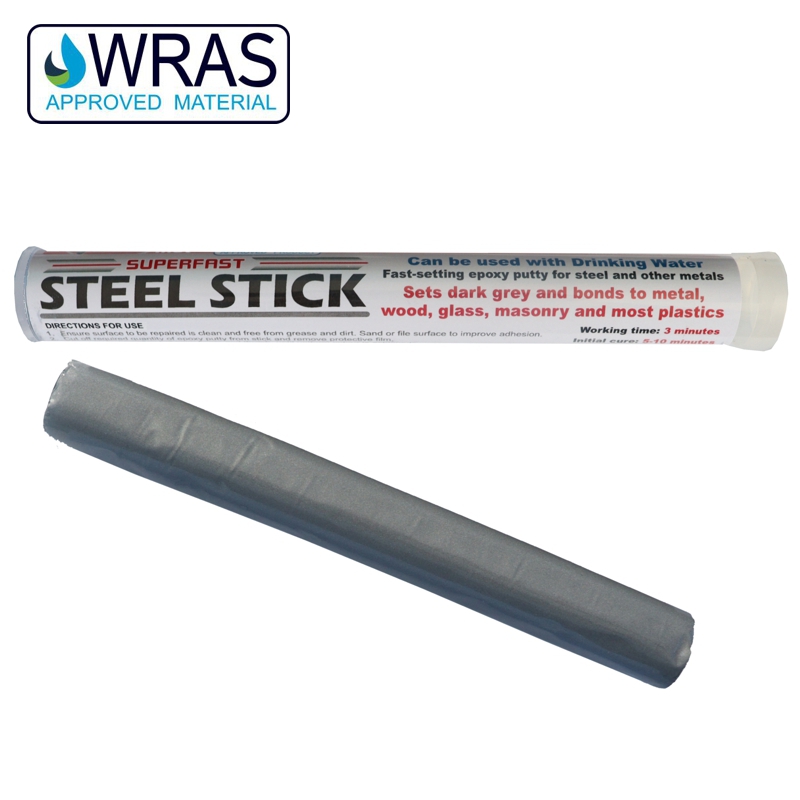
Superfast Steel is a steel-filled epoxy putty stick made at Sylmasta’s plant in the United Kingdom, with the company based in Sussex. It is aimed at cracks in steel and iron, and at rebuilding the profile of industrial pipe and other ferrous metal. The stick uses the usual core-and-outer layout, so a cut piece is kneaded until the colour is even and then pressed into the damage while it is still soft. Work time is about 3 minutes, which suits a small leak that needs to be sealed with little downtime. That same speed is the limit on larger shaping jobs, because the putty can firm before the profile is right. Functional cure is around 1 hour, and the service temperature is quoted up to about 150°C. The cured colour is metallic grey, so a patch on bare steel is less obvious before paint. It carries WRAS approval for pipes and fittings that carry drinking water, which many general repair sticks do not. After cure it can be tapped, drilled, sawn, machined and painted, and it is described as resistant to water, chemicals and temperature extremes. It does not rust, shrink or pull away once hard. Unused stick stays usable if it is resealed in the original pack. It is a strong trade stick for ferrous metal, and a weaker match for plastic, wood or a long sculpt.
Key features
-
Steel-filled formula for iron, steel and other ferrous metal
-
About a 3 minute work time for rapid small repairs
-
WRAS approval for drinking-water fittings
-
Cures to a metallic grey colour
-
Made in the United Kingdom
Facts and information
-
Produced at Sylmasta’s UK plant rather than imported as a finished stick
-
Functional cure around 1 hour
-
Max service temperature up to about 150°C
-
Best suited to small repairs where a short open time is an advantage
-
Can be machined and painted after cure
3. Standard Milliput The Milliput Company
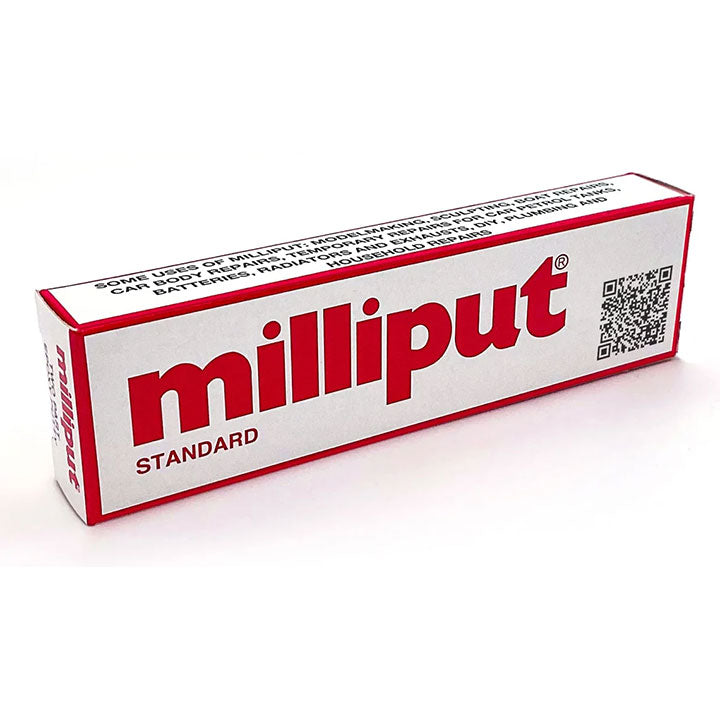
Standard Milliput is the yellow and grey grade from The Milliput Company in Dolgellau, Wales. Jack and Lena Rickman started the firm in 1968 to make a two-part epoxy putty for industry and DIY, and this grade was the first. Each pack holds two 56.7g sticks. Equal amounts are mixed by hand until the colour is uniform. The putty starts soft and highly adhesive, which gives time to shape a chip, a gap or a broken edge, then sets rock hard in about 3 to 4 hours at 20 to 25°C. Gentle heat can shorten that wait to minutes. After it has set it continues to cure for a similar period. Once hard it can be machined, drilled, tapped, turned, filed, sawn, sanded and painted. It bonds to wood, brick, cement, metals, concrete, many plastics and glass, though it is not meant as a thin-film glue. It will set under water and resists heat to about 130°C, which is below the hotter metal sticks used on steam pipe. Stored cool, dry and resealed, it stays workable for about two years. The long open time is a gain for model making and fine fills. It is slow if a leak has to stop before you leave the room.
Key features
-
Two-part yellow and grey sticks, mixed in equal amounts
-
Long working time for shaping and gap filling
-
Sets under water
-
Can be drilled, filed, sawn, sanded and painted after cure
-
Bonds to wood, metal, masonry, many plastics and glass
Facts and information
-
Made in Dolgellau, Wales, since 1968
-
Pack size two sticks of 56.7g
-
Rock hard in about 3 to 4 hours at normal room temperature
-
Heat resistance up to about 130°C
-
Shelf life about 2 years if stored cool, dry and resealed
4. Superfast Copper Epoxy Putty Stick Sylmasta
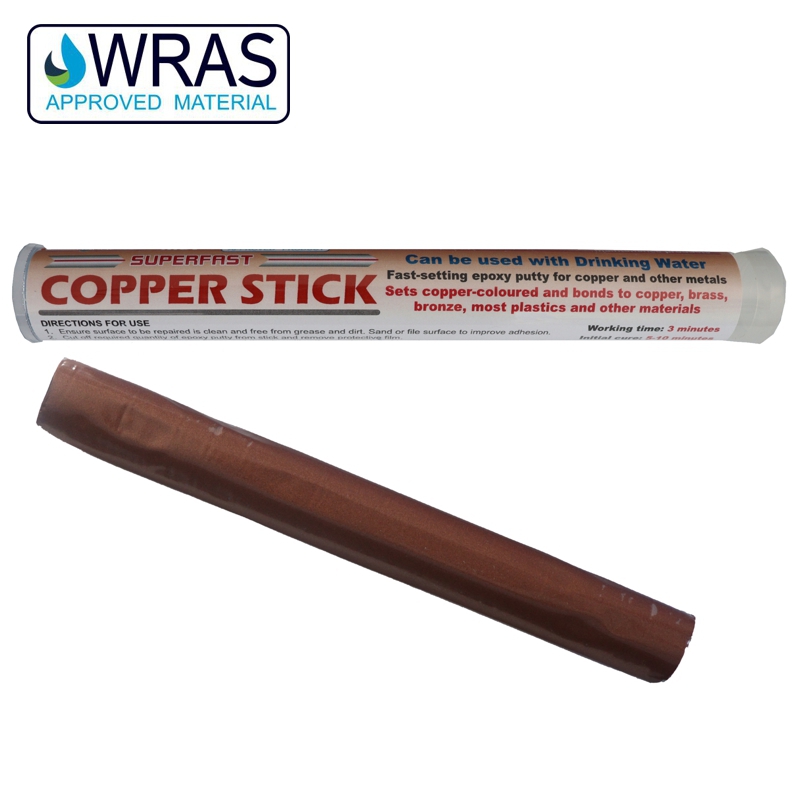
Superfast Copper is Sylmasta’s non-ferrous stick, made in the United Kingdom, for copper pipe, brass, bronze and other non-ferrous metal. Domestic leaks and small industrial pipe repairs are the main use, including elbows, joints and worn fittings where a steel-filled stick would be the wrong metal. Like the steel grade, it carries WRAS approval, so it can be used on pipes and fittings that carry drinking water. The cure colour is suited to copper-toned metal, which makes a patch less obvious before any paint goes on. Open time sits in the fast Superfast band, so the method is cut, knead to one colour, and wrap or press at once. That speed is useful on a pinhole and awkward on a long rebuild, because the mix can skin before the shape is finished. After cure it can be machined and painted, and it is resistant to water and many chemicals. It is less useful on steel, plastic or wood, where a matched stick holds and looks better. For a plumber who wants a UK-made copper stick with drinking-water approval, it is a serious option beside a wider multi-material range.
Key features
-
Formulated for copper, brass, bronze and other non-ferrous metals
-
WRAS approval for drinking-water fittings
-
Fast set for small pipe leaks
-
Made in the United Kingdom
-
Can be finished after cure
Facts and information
-
Produced in Sussex, United Kingdom
-
Aimed at elbows, small pipes and non-ferrous damage rather than large fabrication
-
Drinking-water approval sets it apart from many general copper-coloured sticks
-
Short open time, so the patch should be shaped as soon as the colour is even
-
Unused portions stay fresh if resealed in the original pack
5. Superfine White Milliput The Milliput Company
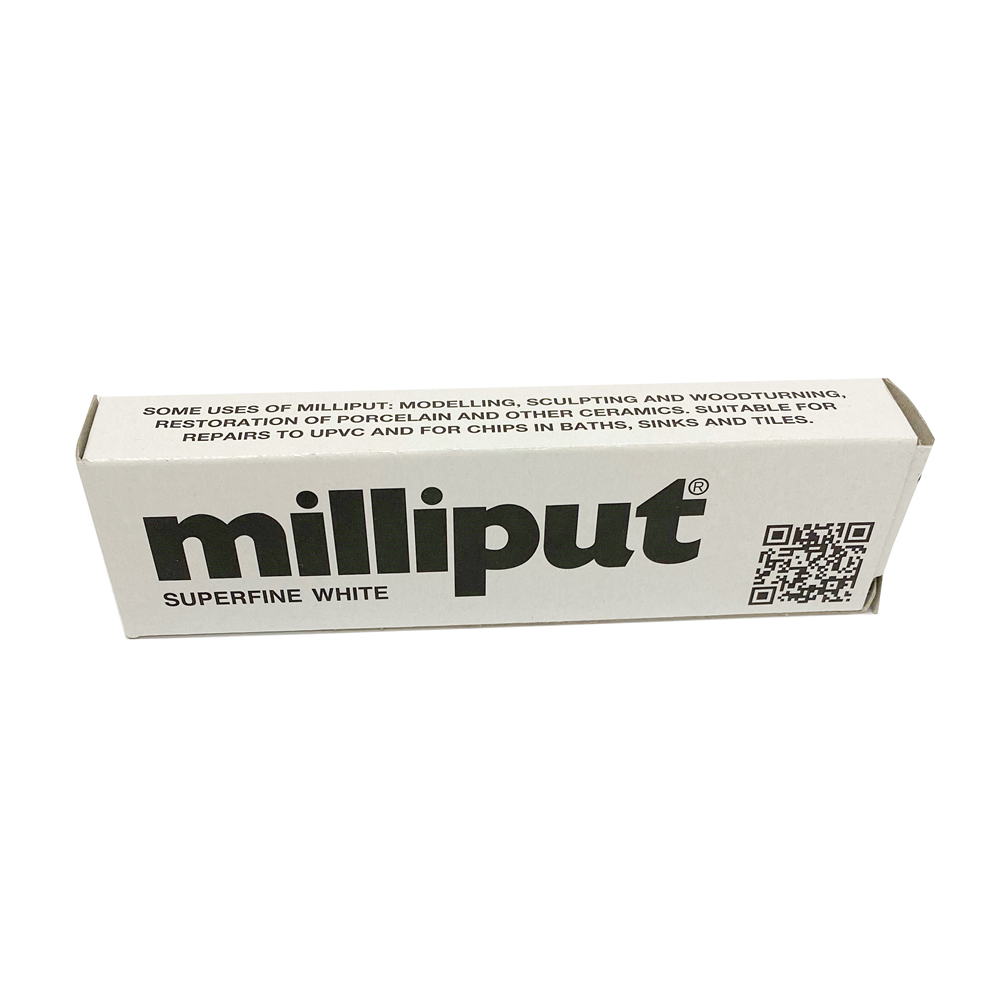
Superfine White came from The Milliput Company in 1983 after porcelain restorers asked for a white putty that Standard yellow-grey could not match. It is still made in Dolgellau, Wales. The grade is finer than Standard, so it suits ceramics, pale models and repairs where a dark mix would show through paint. Cure behaviour matches the rest of the Milliput family. Equal parts are kneaded to an even colour, the putty stays soft and sticky at first, and it becomes rock hard in about 3 to 4 hours at 20 to 25°C. It then continues to cure for a similar period. It sets under water, resists heat to about 130°C, and can be sanded and painted once set, then drilled, filed and sawn when fully cured. The fine texture is a real gain on china, figurines and small chips. On a rough steel patch, a hot pipe or a wet emergency leak, a metal-filled or underwater stick is the better fit. Kept cool, dry and resealed, the sticks stay workable for about two years. It remains a proven UK putty for restorers who need a clean, paintable white.
Key features
-
Fine white grade for ceramics and detailed fills
-
Same equal-mix method as other Milliput grades
-
Paintable and sandable once set
-
Sets under water
-
Made in Wales
Facts and information
-
Introduced in 1983 for porcelain restoration
-
Two 56.7g sticks per pack
-
Sets in about 3 to 4 hours at 20 to 25°C
-
Heat resistance about 130°C
-
Finer particle feel than Standard Milliput
6. Superfast Aqua Potable Water Epoxy Putty Stick Sylmasta 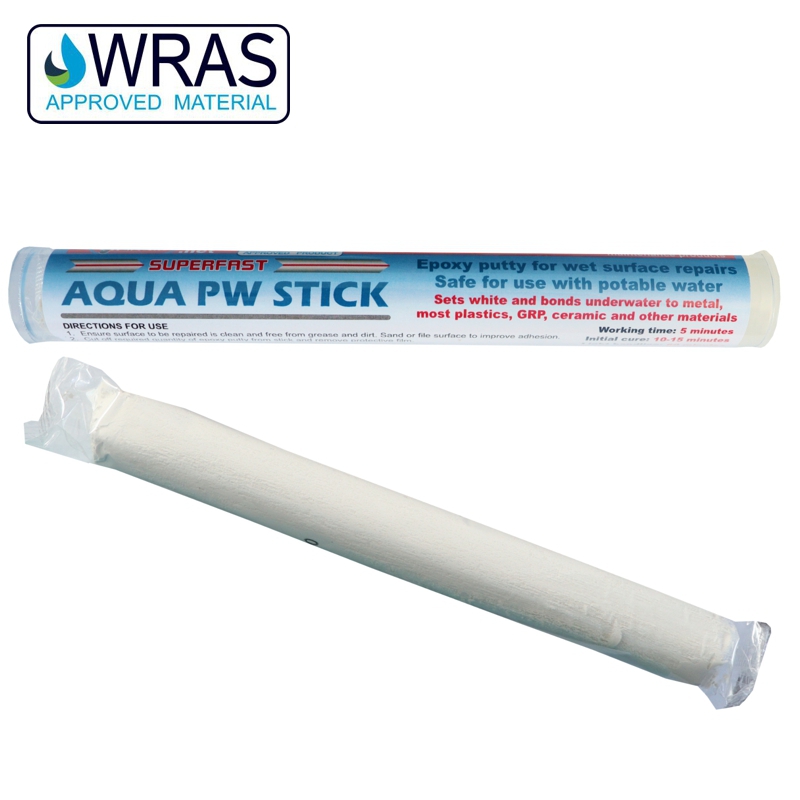
Superfast Aqua is the wet-surface stick in Sylmasta’s UK-made range, produced in Sussex. It is formulated for high adhesion under water, with a cure quoted at about 5 minutes, and it carries WRAS approval for pipes and fittings that carry drinking water. That combination is aimed at live leaks where the line cannot be drained and a dry-only stick would lose its grip. The stick is kneaded to one colour and pressed into place at once, with pressure held until it grabs. It has also been used with a pipe repair bandage on leaks checked against an ASME method for leaking components. The very short open time leaves little room to reshape a corner or a cosmetic fill. Dry indoor chips, model work and slow masonry repairs are better served by a longer-working putty. After cure it can be machined and painted, and it resists water. For a submerged or potable-water pipe repair, the approval and wet grip are the point of the product, not all-round household use.
Key features
-
High underwater adhesion
-
About a 5 minute cure
-
WRAS approval for drinking water
-
Made in the United Kingdom
-
Used on wet pipes and fittings
Facts and information
-
Manufactured at Sylmasta’s UK plant
-
One of three Superfast sticks with WRAS approval, alongside steel and copper
-
Short open time suits emergency leaks more than sculpted repairs
-
Often paired with a reinforcement bandage on larger pipe leaks
-
Not the first choice for dry, slow shaping jobs
7. Terracotta Milliput The Milliput Company
Terracotta Milliput was added in 1992 for pots, urns, brickwork and quarry tiles. It is made in Dolgellau by The Milliput Company and follows the same two-stick mix as the other grades. Equal amounts are kneaded until the colour is even, then pressed into chips and cracks. The cured shade sits closer to fired clay than a grey industrial stick, so garden ornaments and brick repairs need less paint to disappear. Set time is about 3 to 4 hours at room temperature, with a further cure after it has gone hard. It will set under water and takes heat to about 130°C. Once cured it can be sanded, drilled, filed and painted. It is not a structural steel repair product, and the colour is wrong for bare copper or aluminium. Hot pipe and fast leak work sit outside its best use. For masonry, terracotta and outdoor ornaments, the shade and the long shaping time are the reason people keep a pack in the shed. Resealed and stored cool and dry, it stays workable for about two years.
Key features
-
Terracotta colour for clay, brick and tiles
-
Long open time for shaping chips and cracks
-
Sandable and paintable
-
Sets under water
-
Made in Dolgellau, Wales
Facts and information
-
On sale since 1992
-
Two 56.7g sticks per pack
-
Rock hard in about 3 to 4 hours at 20 to 25°C
-
Heat resistance about 130°C
-
Aimed at ornament and masonry repair rather than pipe or engine work
8. Superfast Aluminium Epoxy Putty Stick Sylmasta
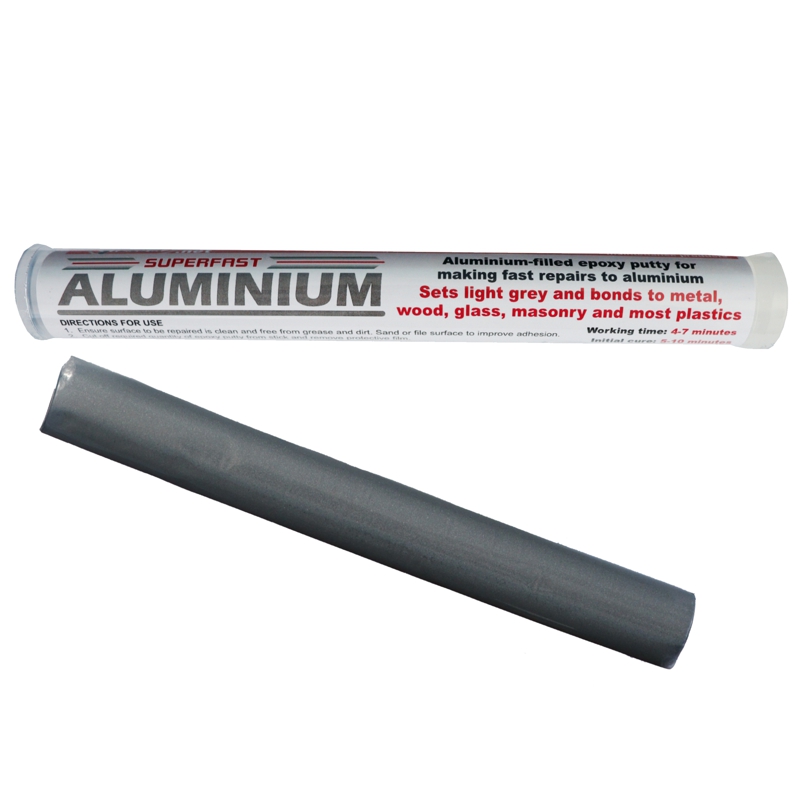
Superfast Aluminium is Sylmasta’s UK-made stick for aluminium and its alloys, produced in Sussex. Typical jobs include radiators, tanks, castings, boats and industrial kit where a steel-filled stick would be the wrong metal. Work time is about 4 minutes, and it sets to a metallic colour, so a small crack can be sealed before a shift ends. The stick is cut, kneaded to one shade and forced into the damage while soft. That short window makes large panel shaping harder, and a cold stick needs warming in the hands before it will blend. It does not carry the drinking-water approval quoted for the steel, copper and aqua grades. After cure it can be drilled, machined and painted, and it resists water and many chemicals. On car radiators and alloy castings it is a direct rival to other aluminium sticks. A household user who also needs plastic and underwater options may still prefer a multi-stick range that covers those surfaces in matched formulas.
Key features
-
Aluminium-filled for alloy repairs
-
About a 4 minute work time
-
Used on radiators, tanks, boats and castings
-
Made in the United Kingdom
-
Can be finished after hardening
Facts and information
-
Produced in Sussex, United Kingdom
-
Part of the wider Superfast stick family
-
Fast open time, so larger builds need planning
-
No WRAS approval listed for this grade
-
Cures to a metallic colour that can be painted
9. AB Original Epoxy Putty Stick Sylmasta
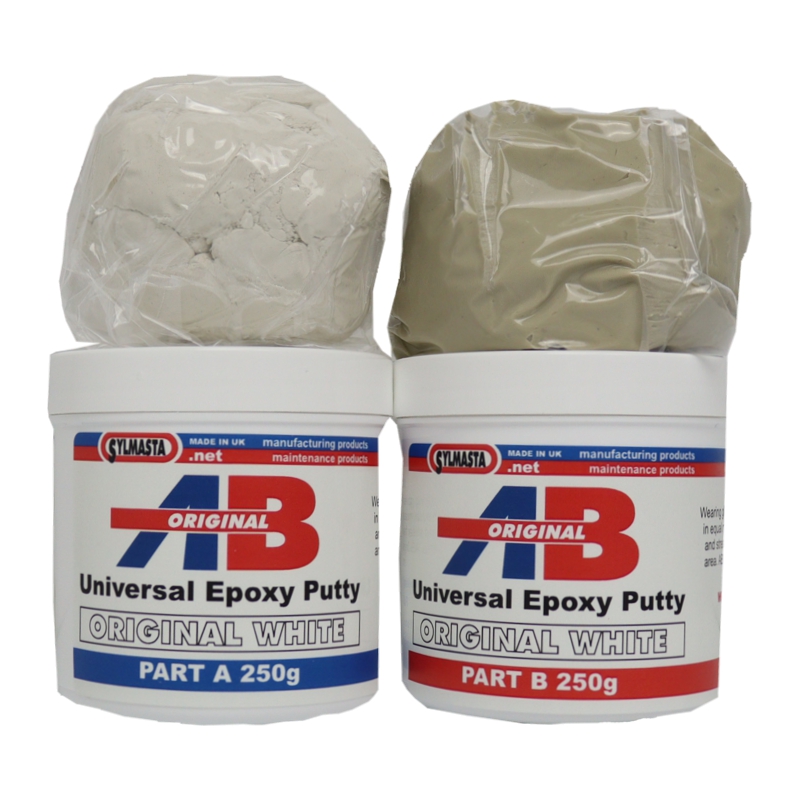
AB Original is Sylmasta’s general-purpose putty, ceramic-filled and made in the United Kingdom. The stick version gives about a two-hour work time, far longer than the Superfast grades. That window helps complex shapes, deeper fills and warm rooms where a three-minute stick would kick off too soon. Greater quantities can be mixed and applied over hours rather than minutes. It bonds to metal, wood, brick, masonry, concrete, porcelain, ceramics, clay and most plastics, cures under water, and is sold in 200g sticks as well as a two-part form. Full cure is about 24 hours. It resists water, chemicals and temperature extremes, contains no solvents, and can be tapped, drilled, sawn, machined and painted. Ceramic fill makes it hard-wearing. It will not match a steel or copper stick on colour or on a drinking-water approval. Custom colours can be made for trade orders, which helps restoration work and matters less on a one-off home fix. For fiddly shaping it is strong. For a fast pipe leak, a short-open stick is the better tool.
Key features
-
Ceramic-filled general-purpose putty
-
About a two-hour work time
-
Cures under water
-
200g stick format
-
Made in the United Kingdom, with custom colours for trade jobs
Facts and information
-
Manufactured at Sylmasta’s UK plant
-
Full cure around 24 hours
-
Longer open time than Superfast Steel, Copper or Aqua
-
Hard-wearing fill for larger or fiddly repairs
-
Not a like-for-like swap when a metal-matched or WRAS stick is specified
10. Silver Grey Milliput The Milliput Company
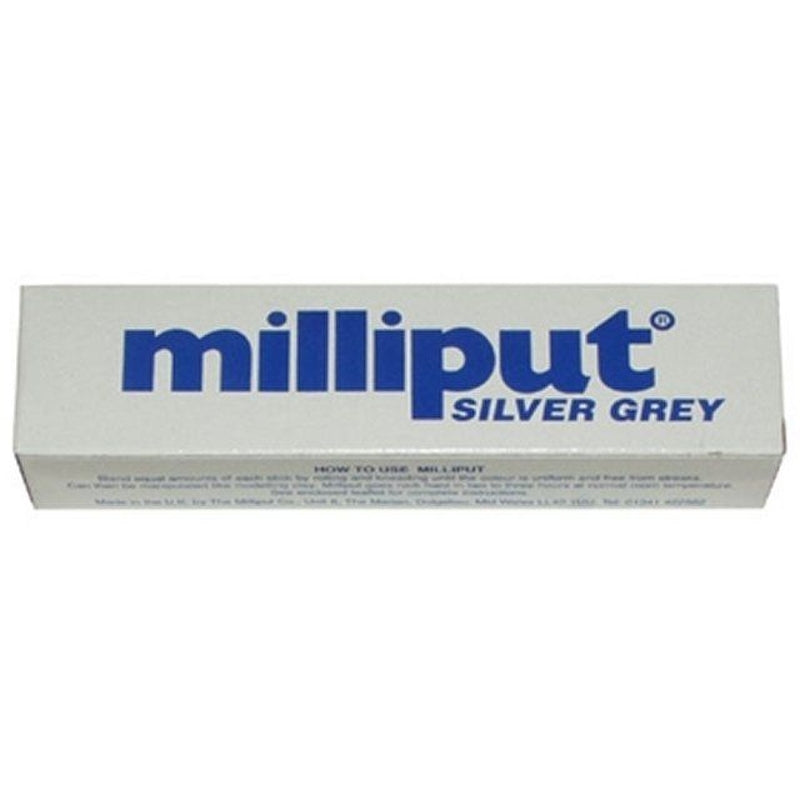
Silver Grey Milliput sits between Standard and Superfine White. The Milliput Company in Dolgellau developed it after the white grade, and military modellers took to the colour as well as restorers. It is slightly finer than Standard and suits stone-coloured garden ornaments, gap filling and general repairs where a yellow mix would look odd. Equal parts are kneaded to an even colour, then shaped while soft. Cure is the familiar 3 to 4 hours to rock hard at room temperature, followed by a further cure of similar length. It sets under water, resists heat to about 130°C, and can be machined, drilled, filed, sanded and painted. Shelf life is about two years if the pack is resealed and kept cool and dry. It is slower than a fast leak stick, and it is not metal-filled, so a hot steel pipe or a drinking-water fitting is outside its best use. For stone, models and mid-tone fills, it is a proven UK putty with a long record in hobby and restoration work.
Key features
-
Silver-grey colour for stone and general fills
-
Slightly finer than Standard Milliput
-
Long shaping time
-
Sets under water and can be painted
-
Made in Dolgellau, Wales
Facts and information
-
One of five Milliput grades, with Standard, Terracotta, Black and Superfine White
-
Two 56.7g sticks per pack
-
Sets in about 3 to 4 hours at 20 to 25°C
-
Heat resistance about 130°C
-
Shelf life about 2 years when resealed and kept cool
11. Black Milliput The Milliput Company
Black Milliput went into production in 2007 for restorers working with marble, slate, ceramics, cast iron and ebonised wood. It is made in Dolgellau by The Milliput Company and uses the same two-stick mix as the other grades. Equal amounts are kneaded until the black is uniform, then pressed into chips, gaps and broken edges. The dark cure helps a repair disappear on slate, cast iron and dark timber before any paint is added. Set time is about 3 to 4 hours at 20 to 25°C, with underwater setting and heat resistance around 130°C. Once hard it can be sanded, drilled, filed and painted. It is not a fast emergency leak stick, and it is not approved as a drinking-water product. Hot steam pipe is also outside its range. For dark stone, iron and ebonised wood, the colour and the long open time are the reason it sits beside Silver Grey and Terracotta in the same Welsh range. Reseal the unused sticks and keep them cool and dry.
Key features
-
Black grade for slate, cast iron, dark ceramics and ebonised wood
-
Long open time for shaping
-
Sets under water
-
Sandable, drillable and paintable after cure
-
Made in Dolgellau, Wales
Facts and information
-
In production since 2007
-
Two 56.7g sticks per pack
-
Rock hard in about 3 to 4 hours at room temperature
-
Heat resistance about 130°C
-
Better as a colour-matched filler than as a fast pipe repair
12. Superfast Titanium Epoxy Putty Stick Sylmasta
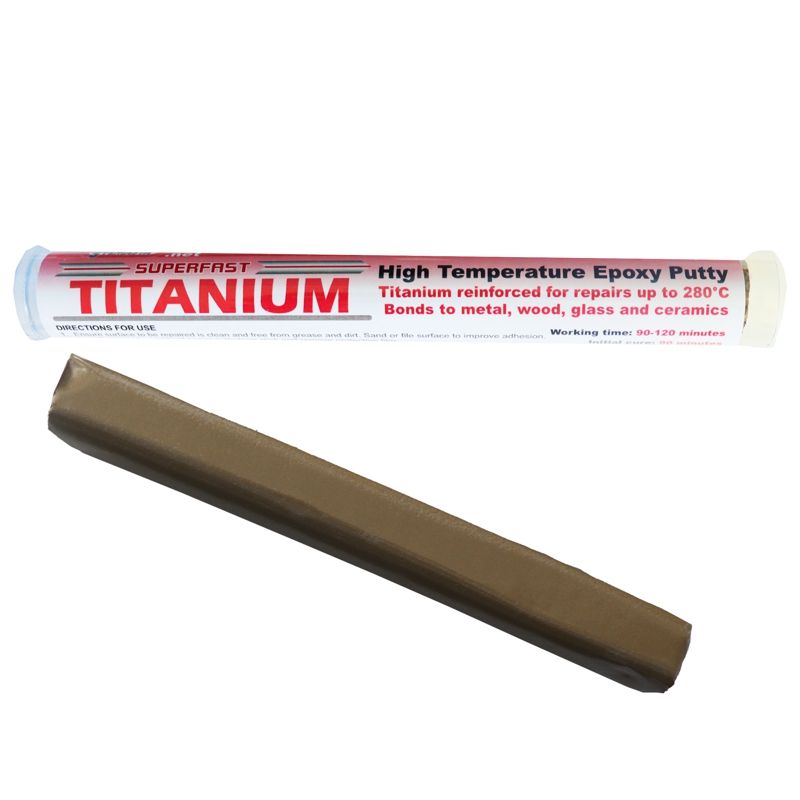
Superfast Titanium is Sylmasta’s high-heat stick, made in the United Kingdom for pipes and metalwork that run hot. Resistance is quoted up to 280°C, which puts it with the specialist heat grades rather than a standard modelling putty. It sets to a golden colour and is described with a work time of about 90 minutes and a functional cure of about 8 hours. That longer open time is unusual in the Superfast family, where steel and aluminium firm in minutes, and it gives more chance to shape a hot-metal repair before the mix locks. It adheres to most materials used in high-temperature settings, including steam pipe and metalwork exposed to extreme heat. It is not the stick for a quick wet leak or a drinking-water fitting, and the slower functional cure means the part stays out of service longer than with a 1 hour steel stick. After cure it can be machined and painted. For heat, it is a serious UK option. For everyday plastic, wood and wet jobs, a matched multi-stick range still covers more surfaces.
Key features
-
Heat resistance up to 280°C
-
About a 90 minute work time
-
Golden cure colour
-
Made in the United Kingdom
-
Used on steam pipe and hot metalwork
Facts and information
-
Produced at Sylmasta’s UK plant
-
Functional cure around 8 hours
-
Longer open time than Superfast Steel, Copper or Aluminium
-
Aimed at extreme heat rather than potable-water approval
-
Can be finished after it has fully hardened
Work Time And Full Cure Explained
Three clocks matter, and mixing them up is how sound patches get sanded too soon. Work time is how long the putty stays soft enough to press into place. Fast UK trade sticks can be down to a few minutes. A general ceramic stick can stay workable for about two hours. Some modelling putties stay shapeable much longer than a leak stick, then firm over several hours.
Functional cure is when the repair can take light duty. On many epoxy putty sticks that is about 60 minutes. A high-heat titanium stick can need longer before it is functional. Full cure is when the patch is hard through and ready to sand, drill and paint. Thin Jenolite layers are often there in 4 to 6 hours. Thick fills and cold rooms add time. Heat shortens it.
|
Stage |
What you can do |
Typical window |
|
Work time |
Knead, press, shape |
A few minutes to about 2 hours, by formula |
|
Functional cure |
Light use, no hard knocks |
Often about 1 hour on fast sticks |
|
Full cure |
Sand, drill, paint |
About 4 hours to a full day |
The notes on what epoxy putty sticks can and cannot do set out where a specialist stick beats a generic one once those times are clear.
Drinking Water Pipe Repairs In The UK
Not every stick belongs on a kitchen tap or a rising main. UK drinking-water fittings need a product approved for that contact. Approval is named on the pack when a stick is cleared for potable water.
Jenolite epoxy putty sticks are industrial grade. They are not certified for potable water or food-contact surfaces. Use them on tanks, boats, tools, housings, gutters and general metal repairs. For a drinking line, the pack needs to name that approval.
Wet repairs are a separate question. A damp tank, a boat fitting or a pipe you cannot dry needs an underwater epoxy putty stick, whether or not the water is for drinking. Isolate pressure if you can. A pinhole is a fair job for putty. A split that opens under full mains pressure may need the line shut off, or a bandage over the stick.
Copper elbows, plastic waste and steel heating pipe are the everyday UK cases. Match the stick to the pipe metal, then cover outdoor steel with a motor care coating or a paint and primer so the weather does not start a new rust line beside the patch.
Surface Prep That Makes A Repair Last
Putty sticks to clean, keyed material. It does not stick well to grease, loose rust or shiny plastic. Scrape or wire-brush first. Oil and silicone need a proper wipe. Active rust under a patch will keep creeping. A rust treatment step on steel, before the stick goes on, stops that creep better than putty alone. Where the rust can stay in place and be changed into a stable film, a rust converter paint route is the other path, used before the topcoat, not instead of filling a hole. Damp fingers help with stickiness while you shape. They do not replace surface cleaning. On a wet repair, use the underwater formula and keep pressure on the patch until it holds.
After The Cure: Sanding, Paint And Heat
Functional strength is not a full cure. Many Jenolite sticks can take light duty in about an hour. Sanding and paint are safer once the patch has gone hard through, often 4 to 6 hours on a thin layer. Thick fills take longer.
Wipe sanding dust off before paint. A cured patch takes normal finishes. On outdoor steel, a paint and primer coat over the repair is what keeps the weather off the metal around the patch. Rust treatment paint is the layer for steel that still has corrosion beside the fill.
Heat limits differ by formula. A titanium stick rated up to 280°C can sit on steam pipe. A standard modelling putty around 130°C cannot. Exhausts, stoves and other very hot parts need a product rated for that heat, not a general stick.
Model makers sometimes want a longer sculpting putty rather than a fast repair stick. Jenolite’s Green Stuff epoxy putty roll is the blue and yellow strip used for miniatures and gap filling, with a slower harden than a leak stick.
Frequently Asked Questions
Can An Epoxy Putty Stick Fix A Leak On A Wet Pipe?
Yes, if the stick is made for wet or underwater work. A dry-surface formula loses grip when water runs through the bond line, so a damp tank, boat fitting or live pipe needs the underwater grade in the epoxy putty stick range. Cut a piece, knead to an even colour, and press it over and past the hole while holding pressure. A small pinhole is a fair job. A split that opens under full mains pressure may need the line isolated, or a bandage over the putty. Jenolite sticks are industrial grade and are not certified for drinking water.
How Soon Can You Sand And Paint An Epoxy Putty Stick?
Light handling is often possible in about an hour on fast metal sticks. Sanding and paint belong after the patch is hard all the way through, commonly 4 to 6 hours on a thin layer, longer if the fill is deep or the room is cold. Warmth speeds the cure. Cold garages slow it. Paint sticks to a cured, dust-free surface, and a paint and primer coat is what protects outdoor steel around the patch. On exterior metal, that paint is doing protection work, not just hiding the colour of the putty.
Will An Epoxy Putty Stick Bond To Every Plastic?
No. Many hard plastics, fibreglass and uPVC repairs work well with a plastic formula from the repair products. Polyethylene, polypropylene and some other soft or waxy plastics often will not hold, even when the mix looks stuck at first. Roughen the area and test a small patch before you rely on it. Metal, ceramic, concrete and wood are more predictable, as long as the surface is clean and keyed. Wood holes follow the same pack-and-strike method set out for filling holes in wood with epoxy.
Is An Epoxy Putty Stick Safe On Drinking Water And Food Surfaces?
Only if the maker states an approval for that contact. Jenolite epoxy putty sticks are not certified for potable water or food-contact surfaces. They suit tanks, boats, tools, housings and general metal repairs instead. A kitchen or drinking line needs a stick that names the approval on the pack. Wet use and drinking-water use are not the same thing. An underwater epoxy putty stick can bond on a damp surface and still be the wrong product for a mains tap.
Which Stick Suits Steel, Copper Or A Hot Pipe?
Match the stick to the metal. Steel putty is the toolbox grade for scratched, chipped and cracked ferrous metal, and the Jenolite steel stick is rated up to 149°C. Copper putty is the plumber’s grade for brass, bronze, elbows, sinks and taps. Titanium is the heat grade, rated up to 280°C, for steam pipe and hot metalwork. Those splits are set out in metal epoxy putty: 4 different types. Aluminium covers car panels, frames and castings. Plastic and underwater sticks cover the other two everyday jobs.
Read Also:
Discover the Best Epoxy Putty Stick in 2026 - Jenolite.



