
Best Metal Epoxy Putty in 2026

A cracked sump, a weeping copper elbow or a holed steel panel needs a fill that sets hard. The best metal epoxy putty in 2026 is a two-part stick you knead by hand, press into the damage and shape before it cures. Metal epoxy putty matches steel, aluminium, copper or hot pipework, then files, drills and takes paint. Many UK workshops keep a stick in the toolbox for that job.
Metal repair is one application within the broader range of epoxy putty compounds, which vary in formulation, consistency and intended use. The guide to the best epoxy putty covers versatile repair applications, while the guide to the best epoxy putty stick explores hand-kneadable sticks designed for convenient filling, bonding and rebuilding.
Discover the Best Metal Epoxy Putty in 2026 - Jenolite.
What Metal Epoxy Putty Does On A Repair

The best metal epoxy putty in 2026 is a hand-mouldable repair compound. You cut a piece from a stick, knead the two parts until the colour is even, and press it into a crack, hole, or chipped edge. The mix starts soft. A chemical cure then turns it into a hard, waterproof fill.
That fill is not a glue film. It rebuilds missing metal. A thin smear will not bridge a hole. A proper plug, often built in layers no thicker than about 25mm, will. Once hard, a good stick can be filed, sanded, drilled, tapped and painted.
Steel, aluminium, copper and titanium do not all want the same mix. A steel-filled stick grips ferrous metal. A copper grade suits brass, bronze and hot water lines. An aluminium grade blends with car panels, frames and outdoor furniture. A titanium-reinforced stick is the pick when heat climbs, such as on steam pipe.
The stick form matters in a real workshop. There is no cup to measure and no resin to spill. Unused putty stays in the pack for years if it has not been kneaded. Jenolite’s range sits with the wider repair products used to seal, bond and rebuild, from gutter leaks to belt slip.
How To Match A Stick To The Metal
Match the stick to the metal and the job, not to the colour of the pack alone.
-
Steel. Use a steel-reinforced stick on mild steel, castings and machined parts. It is the toolbox grade for chips, cracks and small rebuilds.
-
Aluminium. An aluminium-filled stick suits panels, window frames and outdoor furniture. It stays non-rusting after cure.
-
Copper and brass. A copper grade is the plumber’s stick. Elbows, taps, water heaters and leaking hot lines are the usual work.
-
High heat. Titanium reinforcement is aimed at steam pipes and hot metal. Check the stated limit before you wrap an exhaust or a flue.
-
Wet metal. An underwater grade can be pressed onto damp or submerged surfaces. Hold it in place until it grabs.
A generic stick can look the part and still bond weakly. Epoxy putty sticks built for one metal outperform a one-mix-fits-all bar, especially on wet steel. The metal epoxy putty cover copper, titanium, steel and aluminium, each with its own fill. Clean metal still wins. Oil, loose rust and flaking paint sit between the putty and the surface. Knock off scale, then treat what remains before you knead the stick.
Epoxy Putty, Polyurethane Or Superglue For UK Metal Repairs
Metal is not porous, so a glue cannot soak in the way it does on wood. The bond has to grip a smooth face, then live with UK rain, shed cold, heat and workshop chemicals. Three families cover most of that work, and they are not interchangeable.
Epoxy is the usual pick for metal-to-metal. A resin and a hardener start the cure as soon as they meet. Liquid epoxy needs a measured mix and a clamp while it grabs. A stick skips the cups. You knead a pre-measured length and press it on. Once hard it is waterproof, and it can be sanded, drilled and painted. It also does not carry electricity, which helps on fittings near wiring.
Polyurethane is a single-part glue. It likes a little moisture to cure, fills gaps as it expands, and stands up to weather and sunlight. It can join metal to wood, foam or masonry. The bond is usually softer than a cured epoxy plug, and the squeeze-out needs wiping before it skins. It is a construction adhesive more than a hole filler.
Superglue, a cyanoacrylate, grabs in seconds on a clean, dry face. Gel versions stay put better than watery ones on vertical metal. It suits small parts, trim and model work. It is a poor choice for a hole, a wet pipe or an outdoor joint that flexes, because the film is thin and brittle.
Putty wins when metal is missing. A crack, a chipped casting or a weeping elbow needs body, not a film. That is the job of a metal epoxy putty stick. Liquid epoxy still has a place when two flat faces must be glued and clamped. Superglue still has a place on a tiny, dry, indoor join. Around the plug, a rust converter epoxy aerosol turns firm rust into a paintable film before a topcoat goes on.
How To Apply Metal Epoxy Putty Step By Step
A lasting fill follows the same order every time. Rush the prep and the plug lifts, even if the stick itself is sound.
-
Cut back to sound metal. Wire-brush loose rust, flaking paint and scale. Wipe oil and grease off. A rough face keys better than a polished one.
-
Treat what rust remains. Tight rust in the pores still blocks a bond. A rust remover liquid clears it. A converter is the other path when the rust is firm and blasting is not an option.
-
Knead a small piece. Cut only what the hole needs. Knead until the colour is even. Metal grades usually want to go on within a couple of minutes.
-
Press, do not smear. Force the putty into the crack or hole. On a wet-rated grade, hold pressure until it grabs. Build in layers rather than one thick lump, and keep each layer under about 25mm.
-
Shape, then leave it. Smooth the face with a wet finger or a tool. Do not drill or load it at the functional stage. Full cure on a thin layer is often a few hours. Thick sections take longer.
-
Finish. File, sand, drill and paint once it is hard. A metal primer evens the edge between fill and steel before colour from the paints and primers range goes on.
Gloves help. Uncured epoxy can irritate skin. Work where air can move, and close the unused stick so the next repair is still fresh.
What Metal Epoxy Putty Resists In Daily Use
A cured metal stick is built for the conditions that peel ordinary glue off steel.
Water. Once fully cured, a proper metal grade is waterproof. Outdoor furniture, tanks, and gutters are normal work. Wet application is separate. Only an underwater grade should go onto a damp or submerged face, and it still needs to be held until it keys.
Heat. This is the limit people miss. A steel stick rated around 149°C is fine on a warm pipe and wrong on a flue that runs hotter. Titanium reinforcement, rated to 260°C on the Jenolite grade, is the stick for steam and hot metal. A high-heat paste goes further, but it is a measured mix, not a pocket stick.
Chemicals and weather. Cured epoxy stands up to many workshop oils, fuels and dilute cleaners, and it copes with indoor and outdoor swings. It is not a coating. Bare steel around the plug still rusts if moisture sits there. A later film from the anti-rust coatings range closes that gap.
Load and impact. Putty rebuilds a chip, a crack or a small hole. It does not put strength back into metal that has wasted to paper, and a thick plug can crack if it is hit again and again. Cut back to sound steel on a large hole, then fill.
Best Metal Epoxy Putty in 2026
1. Jenolite Epoxy Putty Repair Sticks - Best Metal Epoxy Putty
Jenolite metal epoxy putty is hand-mixed, two-part sticks made in Britain for steel, aluminium, copper, titanium, plastic and underwater repairs. Cut a length, knead until the colour is even, and press it into cracks, holes and chipped metal. The 112g, 7 inch stick is usable within 60 minutes on the metal grades, and it cures waterproof. Steel stays sound up to 149°C. Titanium reinforcement handles heat up to 260°C, which suits steam pipes and hot metal. Copper grade is the plumber’s stick for brass, bronze, taps and leaking hot lines. Aluminium grade rebuilds car parts, window frames and outdoor furniture. Once hard, the fill can be drilled, tapped, filed, machined and painted. A British, family-owned maker with roots in 1939, Jenolite built these sticks for workshops that already trust its rust care. The stick form skips measuring cups, so a small repair stays simple.
Epoxy Putty Repair Sticks | 7 Inch (112g) Tube | Plastic, Steel, Underwater, Copper, Aluminium, Titanium

Description (Epoxy Putty Repair Sticks | 7 Inch (112g) Tube | Plastic, Steel, Underwater, Copper, Aluminium, Titanium):
-
HAND MIX & APPLY: JENOLITE Epoxy Putty Sticks are two-part epoxy repair sticks that you knead by hand, then press into place to rebuild, fill and bond damaged parts.
-
MULTI-SURFACE APPLICATIONS: Each stick is made for a specific substrate, covering metal, steel, aluminium, copper, titanium, plastic, fibreglass, ceramics and similar materials.
-
WEATHER PROOF & RESISTANT TO CORROSION: Suitable indoors and outdoors. The cured epoxy putty resists water, chemicals and temperature extremes.
-
FAST ACTING: Usable within minutes and typically fully functional in 60 minutes. Check the technical data sheet for exact cure times by variant.
-
DURABLE: Hand-mix the two parts into a polymer compound, then mould, wrap or build it up to join and repair components. Once fully cured it is waterproof and can be sanded, sawn, drilled and painted.
-
PLASTIC EPOXY PUTTY: A two-component stick for repairing and rebuilding most major plastic types. After mixing, the fast-setting epoxy bonds to rigid and semi-flexible plastic and can be moulded, wrapped or built up to restore the damaged area.
-
TITANIUM EPOXY PUTTY: A non-rusting, titanium-reinforced epoxy for cracked, snapped or holed metal. Industrial-strength and rated for high-temperature use up to 260°C. Functional after 60 minutes. Once fully cured it is waterproof and can be drilled, tapped, machined, ground, filed and painted.
-
ALUMINIUM EPOXY PUTTY: A non-rusting, aluminium-reinforced epoxy for scratched, chipped or cracked metal. Mix by hand and apply straight to the repair. Once fully cured it can be drilled, tapped, machined, ground, filed and painted. A practical workshop repair stick for mechanics.
-
STEEL EPOXY PUTTY: A non-rusting, steel-reinforced epoxy for rebuilding and repairing metal. Mix by hand and press onto scratched, chipped or cracked areas. Industrial-strength, withstands temperatures up to 149°C, and is functional after 60 minutes. Once fully cured it is waterproof and can be drilled, tapped, machined, ground, filed and painted.
-
COPPER EPOXY PUTTY: A two-component stick for pipes, tanks, hot lines and vessels in brass, copper, bronze and other non-ferrous metals. Use it on plumbing elbows, sinks, taps and water heaters, and to seal freeze breaks. Hand-mix, mould to the joint, and once fully cured it is waterproof and can be sanded and painted. A plumber’s epoxy for leaking hot pipework.
-
UNDERWATER EPOXY PUTTY: A hand-mixable epoxy for damp, wet and submerged repairs in fresh or salt water. Bonds to fibreglass, concrete and similar substrates. Suited to marine decks and hulls, swimming pools, hot tubs, spas, recreational equipment, and leaking tanks and gutters. Functional after 60 minutes. Once fully cured it is waterproof and can be drilled, tapped, machined, ground, filed and painted.
-
MADE IN THE UK
-
Please note: Packaging may differ from the images shown because of label updates. Contents and quality are unchanged.
Green Stuff | Epoxy Putty Roll | Blue & Yellow Strip | 36 Inch

Description (Green Stuff Epoxy Putty Roll | Blue & Yellow Strip | 36 Inch):
-
STRONG ADHESIVE PUTTY: JENOLITE Green Stuff Epoxy Putty Roll is a two-part epoxy putty for sculpting, gap filling and small repairs. The blue and yellow strip kneads into a strong, mouldable green putty that hardens into a durable finish.
-
SCULPTING & MODELING: Formulated as a sculptor’s epoxy putty, Green Stuff is used to build miniature models and parts from scratch, or to repair and modify existing pieces. It holds fine lines and shapes for detailed work.
-
DIY REPAIRS: Bonds well to stone, ceramic, metal, wood and many plastics, including vinyl, so it suits small household and hobby repairs as well as model making.
-
EPOXY SCULPTING PUTTY: Cut only the length you need to limit waste, then hand-mix and sculpt it to shape. Once fully cured it can be glued, sanded, filed, cut and painted.
-
USED BY: Tabletop gamers use Green Stuff to adapt and create miniature models. It is a popular modelling putty for Warhammer and other miniature gaming formats where fine detail matters.
Pick a Jenolite metal epoxy putty.
Discover Also:
2. Sylmasta Superfast Steel Epoxy Putty Stick
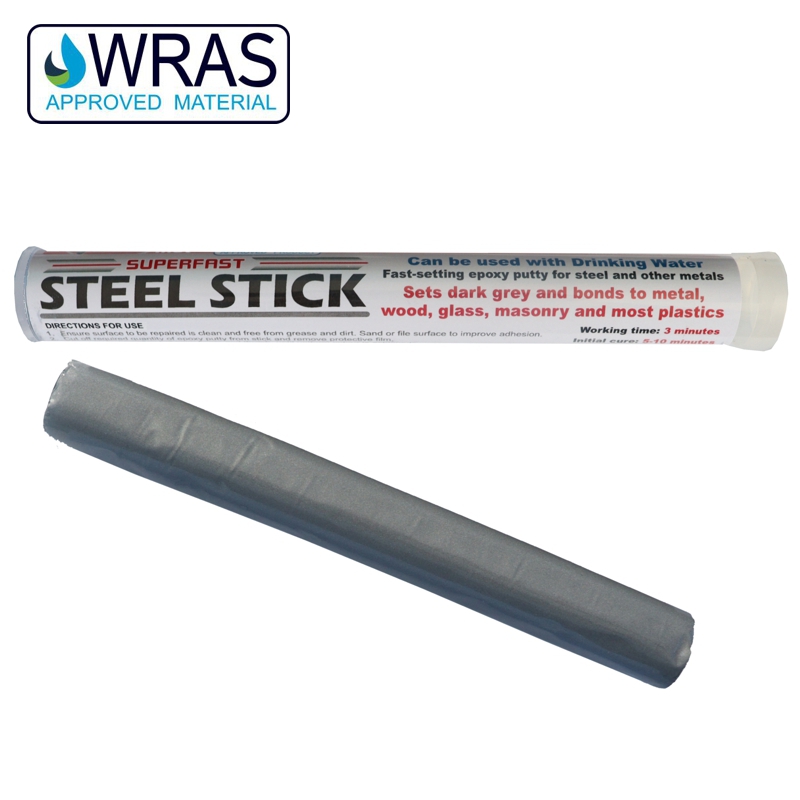
Sylmasta Superfast Steel is a steel-filled epoxy putty stick made at the firm’s plant in Sussex and sold for pipe, tank and plant repairs across the UK. The stick is kneaded by hand until the colour evens out, then pressed into a hole, crack or scored face. Work time is short, about five minutes, which suits a small leak once the line is isolated and limits a large rebuild, because the mix can firm before the shape is finished. A functional cure is often reached in about an hour, and the stated service temperature sits around 150°C. The cured fill turns a grey, metallic colour, and it can be sanded and painted so a repair blends with surrounding steel. Selected sticks in the Superfast family carry WRAS approval for drinking-water fittings, which matters on potable pipe and tanks where that mark is required. Sylmasta makes the sticks in the UK rather than importing them, and it offers custom colours and cure times on top of the standard range. Standard and larger-diameter sticks are both supplied. The grade is aimed at holes, cracks and pipe seals on ferrous metal. On brass or copper, a copper-filled stick is the closer match. On a job that needs a long time to sculpt, the fast set is the main limit.
Key Features
-
Steel-filled stick made in Sussex.
-
Work time around five minutes, functional cure around one hour.
-
Service temperature up to about 150°C.
-
WRAS approval on selected drinking-water grades.
-
Can be sanded and painted after cure.
Facts and Information
-
Supplied as standard and larger-diameter sticks.
-
Aimed at holes, cracks and pipe seals where pressure can be isolated.
-
Fresh stock is a stated benefit of UK manufacture.
-
Short work time can rush a complex shape.
-
A copper grade is the closer match on non-ferrous pipe.
3. Milliput Standard Epoxy Putty
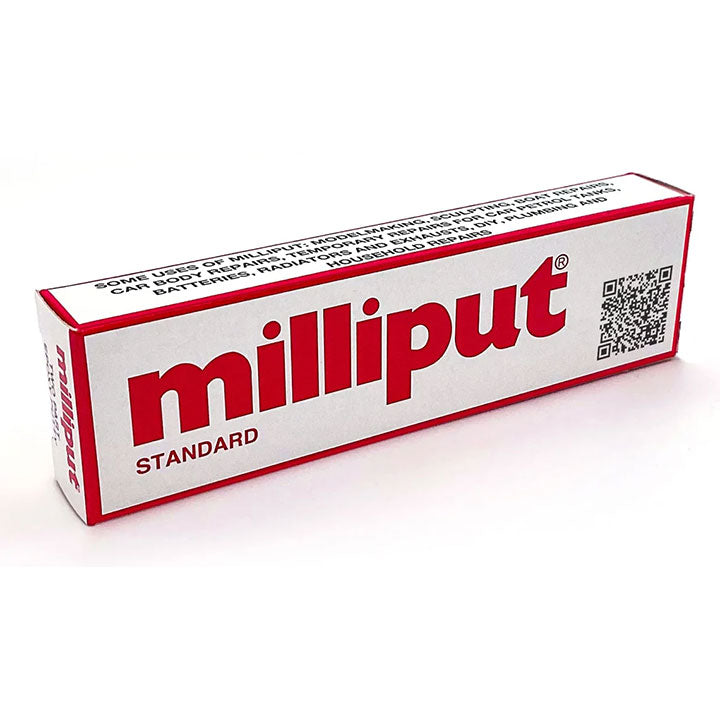
Milliput Standard comes from The Milliput Company in Dolgellau, Wales, and it has been a UK workshop putty for many years. Two equal sticks are kneaded together until the colour is even. At about 20°C the mix stays workable for roughly one and a half to two hours, sets hard in three to four hours, and reaches full cure in about 24 hours. Heat resistance is about 130°C continuous, with short peaks a little higher. It bonds metal, ceramics, wood, brick and many plastics, and it will set underwater, though it is not meant as a thin-film glue. After cure it can be carved, drilled, tapped, filed, sawn and painted, which is why model makers and restorers use it for dents, scores and missing edges. Shrinkage is very low, and Shore D hardness sits around 80 to 85. The long open time helps fine filling and shaping. It is less handy when a leak needs a grab in minutes, because the plug stays soft while a fast stick would already be holding. Pack size is about 113g. Silver grey, black and a metallic grade sit beside Standard. For a hot flue or a steam line, the heat limit is the point to check before the mix goes on.
Key Features
-
Two-part sticks, about 113g a pack, made in Dolgellau.
-
Long work time, about 90 to 120 minutes.
-
Heat resistance about 130°C continuous.
-
Sets underwater and machines cleanly after cure.
-
Bonds metal, ceramics, wood and many plastics.
Facts and Information
-
Shore D hardness around 80 to 85 once cured.
-
Shrinkage is very low.
-
Initial set about three to four hours, full cure about 24 hours at 20°C.
-
Also sold in silver grey, black and a metallic grade.
-
Better for shaping than for a fast pipe stop.
4. Belzona 1111 Super Metal

Belzona 1111 Super Metal is a paste epoxy from Belzona in Harrogate, built for shafts, bearing housings, casings, tanks, flange faces and pipe. It is mixed by weight, about five parts base to one part solidifier, and applied as a paste that does not slump at a useful thickness. Compressive strength is high after a full cure, and hardness sits around the high 80s on the Shore D scale. Light machining can start within a few hours at room temperature. Full mechanical or thermal load takes longer, often close to a day, and chemical immersion wants longer still. The paste is used to rebuild worn metal rather than to stick two flat faces with a thin film. Surface prep carries the repair. Grit-blasted or well-roughened steel gives the paste a key that a polished face will not. It is a plant-repair product more than a pocket stick, so a small home job can feel oversized, and a wrong mix ratio weakens the cure. Once hard it can be machined back to a working size on a shaft or a housing. For a five-minute plug on a cold pipe, a kneaded stick is the simpler tool.
Key Features
-
Two-part metal repair paste from Harrogate.
-
Used on shafts, housings, flanges, tanks and pipe.
-
High compressive strength after cure.
-
Can be machined once it has firmed.
-
Nil slump at a useful build thickness.
Facts and Information
-
Mix ratio about 5:1 by weight.
-
Hardness typically around 89 Shore D.
-
Ambient cure is slower than a fast stick.
-
Best where the part must carry load again, not where a five-minute plug is enough.
-
Prep quality decides whether the rebuild stays put.
5. Bondloc B2001 Steel Epoxy Stick
Bondloc B2001 is a steel repair stick from Bondloc in Bewdley, Worcestershire. It kneads in about a minute, can be used on wet metal in fresh or salt water, and turns from black to grey as the two parts mix. It hardens in about 10 minutes, can go back into light service in about an hour, and reaches full strength in about 24 hours. Continuous heat resistance is about 121°C, with short peaks nearer 149°C. Typical uses are tanks, drums, pipe holes and porous castings, plus fibreglass cracks where a metal-filled plug is still wanted. Once set it can be sanded and painted. Compressive strength sits around 83 N/mm² after a full cure, with Shore D hardness around 75. It also bonds wood, concrete and glass, so a mixed repair on a frame or a tank lid is in range. Chemical resistance is fair to good against many workshop fluids, and stronger against alkalis and kerosene than against dilute mineral acids. The fast set suits a leak. A larger sculpted repair has less time to shape, and the 50g pack is smaller than many workshop sticks, so a wide panel wants more than one tube.
Key Features
-
Hand-kneadable steel stick, about 50g, from Bewdley.
-
Hardens in about 10 minutes, light service in about an hour.
-
Usable underwater in fresh or salt water.
-
Continuous service around 121°C, short peaks nearer 149°C.
-
Can be sanded and painted after cure.
Facts and Information
-
Compressive strength around 83 N/mm² after a full cure.
-
Shore D hardness around 75.
-
Bonds metal, fibreglass, wood, concrete and glass.
-
Colour shifts from black to grey as it mixes.
-
Small pack size limits bigger rebuilds.
6. Sylmasta Superfast Copper Epoxy Putty Stick
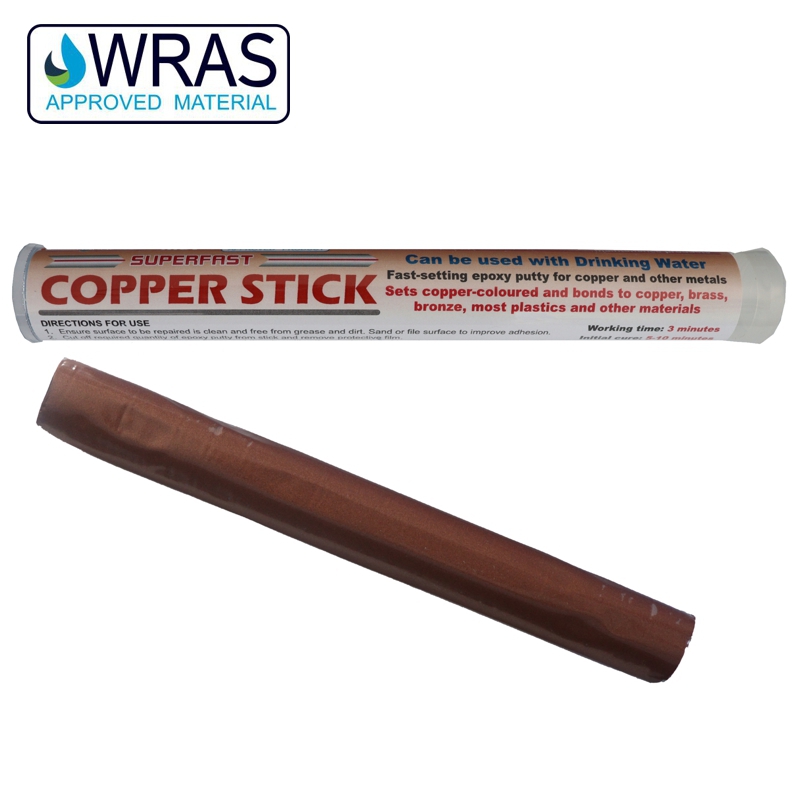
Sylmasta Superfast Copper is the copper-filled stick from the same Sussex maker, aimed at brass, copper and other non-ferrous pipe. It is kneaded by hand and pressed into a clean fitting, elbow or tank wall once the line is isolated. Work time sits in the fast band, often under 10 minutes, with a return to service around an hour on pipe where pressure can be turned off. Like the steel grade, selected Copper and Aqua sticks carry WRAS approval, so they are used on drinking-water fittings where that mark is required. The copper colour helps a plumbing repair blend in before paint, which matters on visible taps and exposed pipe. After cure the fill can be sanded and overcoated. It is not the first choice on mild steel fabrications, where a steel fill bonds and looks closer to the parent metal. The short open time is a help on a small weep and a limit if the repair needs sculpting around a union. Sticks are made in the UK, in standard and larger diameters, as part of a wider Superfast family that also covers aluminium, plastic and wet surfaces.
Key Features
-
Copper-filled stick made in Sussex.
-
Fast work time for pipe and fitting repairs.
-
WRAS approval on selected potable-water grades.
-
Can be sanded and overcoated.
-
Colour sits closer to brass and copper than a grey steel stick.
Facts and Information
-
Part of a nine-grade Superfast family.
-
Used where pressure is off and the system can restart in about an hour.
-
Colour match helps on visible brass and copper.
-
A steel stick is a better match on ferrous plant.
-
Made in the UK, in more than one stick diameter.
7. Milliput Metallic Epoxy Putty

Milliput Metallic, launched in 2024 by the Dolgellau firm, is the metal-look grade of the same two-stick system. Equal parts are kneaded until the colour is even, then pressed into a dent, chip or missing edge. It cures at room temperature, machines and sands like Standard, and is often left unpainted where a metallic face is wanted. Heat resistance stays in the same band, about 130°C continuous. Adhesion covers metal, stone, ceramics and many hard plastics, and the cured mass can be drilled, tapped and polished. Work time is long, about one and a half to two hours at room temperature, with a hard set in three to four hours and full cure around 24 hours. That window favours model work, trim repairs and fine dents over an emergency leak. Shrinkage stays very low. It will not replace a steel-filled stick on a load-bearing crack, and it is not the grade for a steam line or a flue. On a visible aluminium or steel chip where paint is not planned, the metallic face is the reason to pick it over Standard.
Key Features
-
Metallic finish from a UK maker in Dolgellau.
-
Same long work time as Standard Milliput.
-
Can be carved, drilled, tapped and polished.
-
Often used without paint.
-
Heat resistance about 130°C continuous.
Facts and Information
-
Full cure about 24 hours at 20°C.
-
Low shrinkage, in line with other Milliput grades.
-
Launched in 2024 as a metal-look option.
-
Visual repairs suit it better than hot, pressured pipe.
-
Not a substitute for a steel-filled stick on a loaded crack.
8. Belzona 1221 Super E-Metal

Belzona 1221 Super E-Metal is the fast emergency grade from the Harrogate range. It is a paste, not a stick, mixed for leaks, scoring and small rebuilds when a line cannot stay down. Cure is quicker than 1111, so a patch can firm while the fitter is still on the job. It bonds to prepared metal and can be overcoated later. The speed cuts shaping time, which is a help on a weep and a limit if the damaged face is large or awkward. Surface prep still decides whether the patch stays. Oil, scale and flaking paint left under the paste are the usual reason a fast repair lets go. It is sold for maintenance teams more than for a one-off home repair, and the mix has to be measured rather than kneaded from a stick. Once hard it can be dressed back and painted. For a single small hole on cold steel, a pocket stick is the simpler route. For a scored shaft or a leaking casing that has to go back into service the same shift, the fast paste is the tool the Harrogate range is known for.
Key Features
-
Fast-cure metal paste from Harrogate.
-
Used for emergency leaks and scored metal.
-
Can be overcoated after cure.
-
Shorter open time than standard Super Metal.
-
Bonds to prepared metal.
Facts and Information
-
Aimed at plant downtime, not modelling.
-
Needs a measured mix.
-
Prep and a sound edge still carry the repair.
-
A stick is simpler for a single small hole.
-
Speed trades away shaping time on a large face.
9. Sylmasta AB Original Epoxy Putty
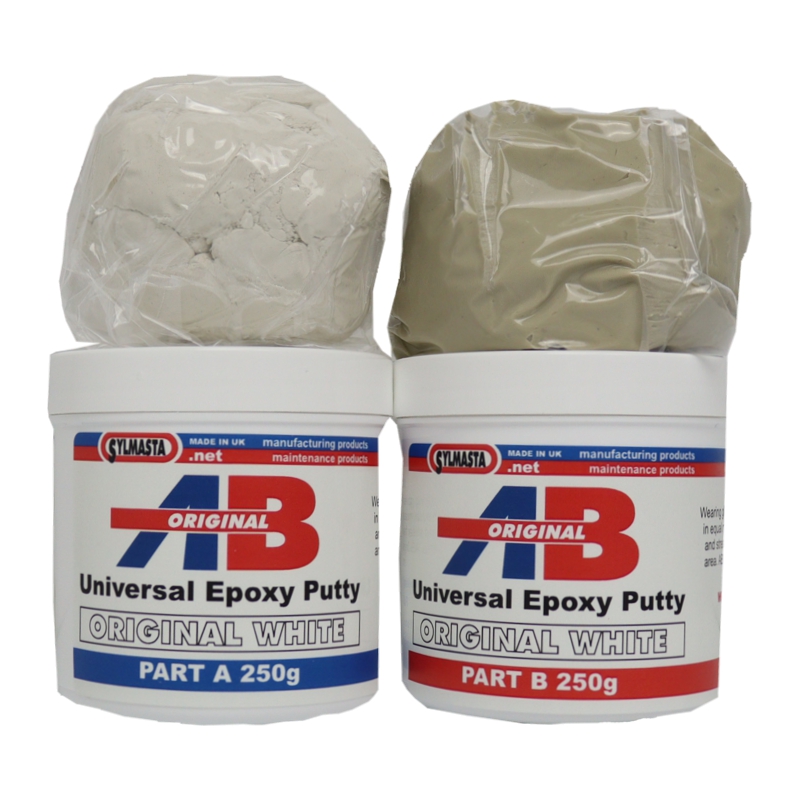
Sylmasta AB Original is the general-purpose putty from the Sussex plant, ceramic-filled and given a work time of about two hours. That long window suits awkward shapes, brick-colour matches and restoration fills where a five-minute stick would firm too soon. It bonds a wide set of materials, resists many chemicals, and can be used underwater. Because it is made in the UK, colour and cure time can be adjusted for a specific job, including matches for masonry and painted metal. A rapid five-minute version exists, but that grade does not bond underwater, so the choice depends on whether the face is wet. AB Original is less metal-like than a steel stick, so a visible steel repair may still want the Superfast Steel grade. The ceramic fill is there for wear, which helps on a surface that gets scuffed rather than on a fine decorative edge. It is hand-mixed and applied like other putties, then left to cure before sanding or paint. For a quick pipe stop, the fast Superfast sticks are the closer pick. For a shaped fill that has to be worked for a while, AB Original is the Sussex grade built for that pace.
Key Features
-
Ceramic-filled putty made in Sussex.
-
About two hours of work time.
-
Usable underwater.
-
Colour and cure can be adjusted to order.
-
Chemically resistant once cured.
Facts and Information
-
Hard-wearing fill for mixed materials.
-
Better for shaping than for a five-minute leak stop.
-
The rapid sister grade is not for wet repairs.
-
Steel-filled sticks look closer to ferrous metal.
-
UK manufacture allows small custom runs.
10. Resimac 101 XHT Metal Repair Paste
Resimac 101 XHT is a high-temperature metal paste from Resimac in Topcliffe, North Yorkshire. It is a two-part, solvent-free epoxy novolac built for hot metal, with dry heat resistance up to 240°C and immersion resistance up to 180°C. It can be built to about 25mm without slump, which suits pitted castings, flange faces and worn housings that a thin glue film cannot rebuild. Working time is about 30 minutes at 20°C if the base component is in the right temperature band, roughly 15°C to 25°C. Below that the paste is stiff. Above it the open time shortens. The mix has to be complete, with no streaks left on the board, or soft spots remain in the cure. It keeps strength as temperature rises, which is the reason to pick it over a standard steel stick on a hot vessel or a steam-side repair. It is a measured paste for plant work, not a pocket stick, so a cold-water pipe or a small aluminium dent is more than it needs to be. Once cured it can be dressed and overcoated. For a hand-kneaded plug on mild steel at room temperature, a stick remains the simpler UK option.
Key Features
-
High-heat paste from Topcliffe, North Yorkshire.
-
Dry heat up to 240°C, immersion up to 180°C.
-
Build up to about 25mm without slump.
-
Solvent-free epoxy novolac.
-
Two-part measured mix.
Facts and Information
-
Use within about 30 minutes of mixing at 20°C.
-
Keeps strength as temperature rises.
-
Needs a proper mix and a warm base component.
-
Oversized for a small cold repair.
-
Aimed at hot plant rather than a toolbox plug.
How Metal Epoxy Putty Fits UK Workshops
UK repairs split into three habits. Home and trade jobs want a stick that kneads in the hand. Plant teams want a paste that rebuilds a shaft or a flange. Plumbers want a copper or wet-surface grade that seals a line once the water is off.
A British stick fits the first habit. Jenolite’s metal grades are made in Britain and sold for steel, aluminium, copper and hot pipe. Other UK makers cover fast steel sticks, long-work modelling putty and heavy plant pastes. The epoxy putty range is the hand-mixed end of that split.
|
Repair |
Better Fill |
What To Watch |
|
Chipped steel or a small crack |
Steel stick |
Clean to sound metal |
|
Aluminium panel or frame |
Aluminium stick |
Keep layers under 25mm |
|
Leaking brass or copper |
Copper stick |
Isolate the line first |
|
Steam pipe or hot metal |
Titanium or high-heat paste |
Check the heat limit |
|
Damp hull, tank or gutter |
Underwater stick |
Hold pressure until it grabs |
|
Shaft, housing or flange |
Industrial metal paste |
Measure the mix |
After the fill, many jobs still need a coating. A cured stick takes paint. On rusty steel around the repair, a rust converter turns firm rust into a paintable film before a topcoat from the paints and primers range goes on.
Metal Epoxy Putty Tips For A Lasting UK Bond
UK sheds, vans and job sites are often cold and damp. That changes how a stick behaves, even when the formula is right.
-
Warm a cold stick in the hand before you knead. A stiff bar mixes in streaks, and streaks stay soft.
-
Dry the face if the grade is not rated for wet metal. Rain on a gate is not the same as an underwater stick on a hull.
-
Roughen shiny aluminium and new steel. A polished face gives the putty little to grip.
-
Test the fit before you mix. Fast grades firm while you are still looking for a clamp or a mesh patch.
-
Keep the repair out of frost for the first cure. A cold night slows the set and can leave a weak plug.
-
Paint the surrounding steel, not only the fill. A good UK anti rust paint for metal stops the next patch of corrosion at the edge.
For a long roll of general putty, rather than a metal-matched stick, Jenolite also sells Green Stuff epoxy putty. Gutter and flat-roof leaks that are not a metal rebuild sit closer to a stop leak sealer spray. Chassis seams that stay hidden often get a wax film such as Waxoil after the repair.
Heat, Water And Cure On Metal Repairs
Heat is the limit people miss. A steel stick rated to 149°C is fine on a warm pipe and wrong on a flue that runs hotter. Titanium reinforcement, rated to 260°C on the Jenolite grade, is the stick for steam and hot metal. A specialist paste such as a high-heat novolac goes further, up to dry heat around 240°C, but it is a mixed paste, not a kneaded stick.
Water changes the job, not the idea. An underwater grade can be applied wet, even on a hull or a pool, if you hold it until it keys. A standard stick may wipe off a wet face. Functional cure on many metal sticks is about an hour. Full strength, and a safe return to pressure, often wants several hours, and thick sections take longer.
Cold sheds slow the cure. A cold stick is stiff to knead and slow to harden. Warm it in the hand first. Do not force a thick plug in one go. Build, let it firm, then add the next layer. The same order sits behind a sound metal repair on a gate, a tank or a car panel.
Getting Rusty Steel Ready For Putty
Putty does not replace rust care. Loose scale, dust and oil block the bond. Wire-brush to firm metal. Where red rust remains in the pores, a rust remover clears it before the stick goes on. A converter is the other path when the rust is tight and blasting is not an option.
Holes in thin steel are a different problem. Putty can plug a small hole. It cannot put strength back into metal that has wasted to paper. Cut back to sound steel, treat the edge, then fill. On cars, the same order applies: treat, fill, then finish with products from the automotive range. A full job kit from the project kits packs remover, tools and paint when the metal needs more than a plug.
FAQ
Can Metal Epoxy Putty Fix A Leaking Pipe?
Yes, if the line can be isolated and the hole is small. A copper grade suits brass, bronze, taps and hot lines. A steel grade suits ferrous pipe. Press the kneaded metal epoxy putty into a clean face and hold it until it grabs. Many sticks are usable in about an hour, but a thick plug wants longer before pressure comes back. A putty plug is not a stand-in for a failed joint on a high-pressure main.
Is Metal Epoxy Putty Waterproof After Cure?
A proper metal grade is waterproof once it has fully cured. That is why the same family is used on outdoor furniture, tanks, gutters and boat fittings. Wet application is a separate claim. Only an underwater grade should go onto a damp or submerged face, and it still needs pressure until it keys. Paint can go on after the cure, which helps the repair match the surrounding metal. A stop leak sealer covers gutter and flat-roof leaks that are not a metal rebuild.
Will Metal Epoxy Putty Stick To Aluminium And Cast Iron?
Aluminium wants an aluminium-filled stick, especially on panels, frames and cast housings. Cast iron and mild steel want a steel-filled stick. Both need a clean, sound face. Oil from machining, and powdery rust, are the usual reasons a fill lets go. After cure, the plug can be filed flush and drilled if a fixing has to go back in. The metal epoxy putty split copper, titanium, steel and aluminium so the fill matches the parent metal.
Does Superglue Replace Metal Epoxy Putty?
No. Superglue bonds small, clean, dry faces in seconds. It does not rebuild a hole, and it is a weak choice on wet or outdoor metal. Polyurethane can join metal to wood or masonry and fill a gap as it expands, but it stays short of a machinable plug. A metal epoxy putty repair stick is the fill when steel, aluminium or copper is actually missing. Liquid epoxy still has a place when two flat faces must be glued and clamped.
How Soon Can Metal Epoxy Putty Be Drilled And Painted?
Functional cure on the metal grades is about 60 minutes, which means the plug can take light handling. Drilling, tapping and paint want a full cure, often a few hours on a thin layer and longer on a thick one. Sand or file the face first so the paint has a key. A metal primer evens the edge between fill and steel before colour goes on. Cold sheds slow that clock, so a warm mix and a frost-free first night give a harder plug.
Read Also:
Discover the Best Metal Epoxy Putty in 2026 - Jenolite.



