
Best Rust Treatment Paint in 2026

Rust can weaken metal fast if left unchecked. Finding the right rust treatment paint stops corrosion and prepares surfaces for a fresh coat. Many people face this issue with cars or garden equipment. The best rust treatment paint turns rusty spots into stable areas ready for use. It saves time and keeps things looking good. Products like these work by reacting with rust to form a barrier against moisture.
Discover Our Best Rust Treatment Paint in 2026 - Jenolite
Understanding Rust and Its Impact

Rust forms when iron meets oxygen and water, leading to flaky red-brown spots. This process speeds up in damp or salty conditions. Some metals rust quicker than others based on their makeup. Treating it early prevents bigger problems like holes or breaks. The best rust treatment paints neutralise rust without much scraping.
How Rust Treatment Paint Works
Rust treatment paints contain acids or chemicals that bind with rust, creating a hard layer. This stops further damage and lets you paint over it. Apply them on clean, dry surfaces for best results. They differ from regular paints by targeting corrosion directly.
Best Rust Treatment Paint in 2026
1. Jenolite - Best Rust Treatment Paint
Jenolite Rust Treatment Paint delivers outstanding performance in halting corrosion and restoring metal surfaces. From the UK, this brand offers a range of formulas designed to neutralise rust effectively, creating a robust base for painting. The products penetrate deep into affected areas, converting rust into a stable compound that prevents further deterioration.
Sprays provide even coverage on awkward shapes, while liquids suit brushing for precise control. Quick drying times mean projects move fast, with treated surfaces ready in minutes to hours. Users value the durable protection against moisture, ideal for vehicles, tools, and outdoor fixtures. The water-based options reduce fumes, making them user-friendly indoors.
Epoxy-infused variants add extra strength for demanding applications, ensuring long-lasting results in tough conditions. Versatile across steel and iron, these treatments enhance adhesion for topcoats, leading to professional finishes. Standout aspects include low odour and non-toxic profiles, appealing to DIY enthusiasts and pros alike.
RUST REMOVER THICK LIQUID | NON-DRIP FORMULA | 150ML, 500ML, 1 LITRE, 5 LITRE

RUST REMOVER THICK LIQUID | NON-DRIP FORMULA | 150ML, 500ML, 1 LITRE, 5 LITRE
DESCRIPTION
-
ELIMINATES RUST QUICKLY: JENOLITE Thick Liquid Rust Remover - A potent and rapid rust dissolver, perfect for stripping corrosion down to clean metal, prepared for priming within half an hour.
-
RAPID PERFORMANCE: This viscous solution interacts chemically with corrosion, simplifying its elimination and conditioning the affected metal. Prepares the area for coating by chemically breaking down rust for straightforward removal.
-
STAY-PUT COMPOSITION: The dense, drip-resistant mixture allows precise application to targeted spots, even on upright areas, guaranteeing it acts solely on intended zones.
-
PERFECT FOR APPLICATION ON: Vehicles, panel repairs, undercarriages, wheel wells, equipment, bicycles, marine vessels, recreational vehicles, fencing, outdoor seating, and more.
-
AREA COVERAGE: Roughly 4 square meters per liter
-
PRODUCED IN THE UK
ORIGINAL RUST REMOVER LIQUID TRIGGER SPRAY | 500ML & 1 LITRE

ORIGINAL RUST REMOVER LIQUID TRIGGER SPRAY | 500ML & 1 LITRE
DESCRIPTION
-
ELIMINATES RUST QUICKLY: This rapid-action remover breaks down rust effectively, exposing clean metal that's prepared for priming.
-
QUICK RESULTS: It chemically interacts with rust for straightforward elimination. The surface is priming-ready within 30 minutes.
-
PERFECT FOR APPLICATION ON: Great for vehicles, body repairs, undercarriages, wheel wells, equipment, bicycles, boat hulls, yacht bottoms, trailer understructures, outdoor entrances, and patio sets, among others.
-
CLEARS OXIDE LAYERS: Ideal for eliminating thin oxide coatings that remain on metal after abrasive blasting like sand or grit methods.
-
USAGE: As with every JENOLITE item, this Rust Remover is user-friendly. Just apply the spray for full surface coverage on rusty areas. Let it penetrate the corrosion while agitating with a wire brush or drill-mounted brush. Maintain the reaction by preventing dryness and reapplying when needed.
-
AREA COVERAGE: Roughly 8 square meters per liter.
-
PRODUCED IN THE UK.
ORIGINAL RUST REMOVER LIQUID | 500ML, 1 LITRE, 5 LITRE

ORIGINAL RUST REMOVER LIQUID | 500ML, 1 LITRE, 5 LITRE
DESCRIPTION
-
QUICKLY ELIMINATES RUST: Since 1939, JENOLITE Original Liquid Rust Remover has been trusted by experts. This rapid formula eradicates rust, exposing clean metal that's primed for coating.
-
RAPID PERFORMANCE: It chemically interacts with rust for effortless elimination. Surfaces are prepped for priming within half an hour.
-
PERFECT FOR: Excellent for stripping rust from instruments, compact metallic items, or hard-to-reach spots like enclosed sections and hollow parts. Suitable for vehicles, panel repairs, undercarriages, wheel wells, equipment, bicycles, vessels, trailers, fences, outdoor seating, and more.
-
ELIMINATES SURFACE OXIDES: Effective for clearing minor oxide layers remaining on metals post-blasting with shot or grit.
-
USAGE METHOD: This smooth, user-friendly liquid rust remover can be sprayed, brushed, or used for dipping.
-
AREA COVERAGE: About 8 square meters per liter
-
PRODUCED IN THE UK
NON-HAZARDOUS RUST REMOVER LIQUID | 1 LITRE, 5 LITRE

NON-HAZARDOUS RUST REMOVER LIQUID | 1 LITRE, 5 LITRE
DESCRIPTION
-
NON HAZARDOUS RUST REMOVER: PH neutral, water-based rust remover that works without scrubbing or sanding, restoring rusted tools, vehicle parts and cookware to like-new condition
-
SAFE ALTERNATIVE: Tackles rust removal jobs quickly and more safely than alternative chemicals as it does not require the use of any protective equipment, gloves or eyewear, due to its non-hazardous formula
-
USE ON: Softer metals such as chrome, copper, brass and aluminium, unlike many harsh alternatives
-
FUEL TANKS: Safe for use on rusty fuel tanks - simply pour in and leave to work. Turn, tank every few hours until all rust is removed
-
EASY TO USE: Simply pour the required amount into a plastic container and immerse small items, or for large items, cover the surface with strong paper towels soaked in Jenolite and place plastic sheeting on top, then leave to work. Heavily rusted items can be left until rust free (24hrs+)
-
REUSABLE: Non-toxic and bio-degradable formula means you can remove rust from your metal items time after time, whilst being kinder to the environment
-
MADE IN BRITAIN
RUST REMOVER CONCENTRATED GEL | 40ML, 1 LITRE, 5 LITRE

RUST REMOVER CONCENTRATED GEL | 40ML, 1 LITRE, 5 LITRE
DESCRIPTION
-
RUST REMOVER JELLY: JENOLITE Rust Remover Concentrated Gel - this reliable and proven formula offers the perfect fix for tackling stubborn rust issues on any metal made from iron or steel. It's great for addressing minor rust spots on vehicles like paint chips, plus on bicycles, home devices, instruments, and outdoor gear.
-
CONCENTRATED FORMULA REMOVES RUST FAST: Quick-working rust remover that obliterates corrosion, exposing clean metal prepared for priming. It can also strip away the thin oxide layer from sandblasting, delivering a pristine, even surface set for priming and coating.
-
FAST ACTING: It chemically interacts with rust to simplify its elimination. Priming-ready in less than an hour.
-
NON-DRIP GEL FORMULA: Apply it using a brush; the drip-resistant composition prevents running, making it suitable for upright areas.
-
IDEAL FOR USE ON: Car rust patches, panels, undercarriage, wheel wells, implements, cycles, vessels, trailers, fences, patio sets, and more.
-
COVERAGE: Roughly 2 square meters per liter.
-
MADE IN BRITAIN
RUST CONVERTER EPOXY AEROSOL | 500ML | TURNS RUST INTO READY TO PAINT SURFACE

RUST CONVERTER EPOXY AEROSOL | 500ML | TURNS RUST INTO READY TO PAINT SURFACE
DESCRIPTION
-
RUST CONVERTER SPRAY: JENOLITE Rust Converter Epoxy Aerosol serves as an effective rust remedy for metallic areas, swiftly transforming corrosion into a solid base suitable for coating.
-
FAST ACTING & SIMPLE TO USE: This rust converter aerosol interacts with corrosion to form a durable substance in just 15 minutes. Apply it directly to rusty spots for quick and effective corrosion control and avoidance. After hardening, the darkened layer can remain untouched or be covered with various water-based or oil-based coatings.
-
EPOXY BASED RUST CONVERTER: Its sophisticated blend eliminates and alters rust while serving as a barrier to stop its recurrence. Perfect as a rust primer for metallic items.
-
AUTOMOTIVE USE & MORE: Great for iron-containing metal areas, it's an excellent rust transformer and remedy for automobiles (like cars, trucks, motorcycles), equipment, devices, outdoor fences, furnishings, and beyond. Eliminates corrosion in hidden spots.
-
LONG-TERM RUST PROTECTION: Forms shielding layers that eradicate rust and guard against moisture, air, CO2, and corrosive elements for enduring defense against oxidation.
-
EASY TO USE: Just apply straight onto corrosion and observe the transformation into a paint-ready dark violet or black layer. Impervious to humidity, oxygen, and CO2; post-treatment, the area can be coated without requiring an undercoat.
-
COVERAGE: Roughly 2.5m² coverage from a 500ml container.
RUST CONVERTER LIQUID TRIGGER SPRAY | 500G & 1 LITRE

RUST CONVERTER LIQUID TRIGGER SPRAY | 500G & 1 LITRE
DESCRIPTION
-
QUICK-REACTING RUST TRANSFORMER: JENOLITE Rust Converter is a rapid, water-based solution that chemically alters rust into a solid foundation, stopping further corrosion by forming a shield against moisture, air, and carbon dioxide.
-
PRIMED FOR PAINTING: After treatment, it changes rust into a surface ready for direct painting with most current paints, eliminating the primer requirement.
-
ENDURING SAFEGUARD: It repels humidity, oxygen, and carbon dioxide, delivering sustained defense to the applied regions.
-
SIMPLE APPLICATION: Effortless to apply. Just spray onto rusty spots and see it convert to a black/purple paintable layer. Skip rinsing or wiping; allow to dry, and the formerly corroded spot is set for coating.
-
OPTION TO LEAVE AS-IS OR OVERCOAT: Once used, it may stay untreated or be finished with water-based or oil-based paints.
-
STRAIGHTFORWARD PROCESS: Fast-working rust neutralizer that bonds with rust to produce a durable compound in just 15 minutes.
-
COVERAGE: Roughly 6 to 8 square meters per liter.
-
MADE IN BRITAIN
RUST CONVERTER LIQUID | 150ML, 500ML, 1 LITRE, 5 LITRE

RUST CONVERTER LIQUID | 150ML, 500ML, 1 LITRE, 5 LITRE
DESCRIPTION
-
QUICK-REACTING RUST TRANSFORMER: JENOLITE Rust Converter features a rapid-action, water-based formula that chemically alters rust into a secure base, halting additional corrosion by forming a shield against moisture, air, and CO2.
-
PREPARED FOR COATING: After application, it changes rust into a surface primed for painting, allowing direct application of most contemporary paints without requiring an undercoat.
-
DURABLE DEFENSE: Blocks moisture, oxygen, and carbon dioxide, offering extended safeguarding for the processed regions.
-
SIMPLE APPLICATION: Straightforward to apply, just brush or spray it straight onto corroded spots and observe as it activates, converting rust to a paint-ready dark violet or black layer. No rinsing or cleaning needed; allow it to air dry, and the formerly rusty spot is set for coating.
-
SUITABLE TO REMAIN EXPOSED OR COATED: Following treatment, it may stay uncovered or be overpainted using paints that are water- or oil-based.
-
STRAIGHTFORWARD PROCESS: Fast-reacting rust transformer that interacts with corrosion to produce a steady substance in about 15 minutes. Applicable via brush or spray for uniform distribution across broad areas.
-
AREA COVERAGE: Offered in spray and liquid versions. Roughly 6 to 8 square meters per liter.
-
MADE IN BRITAIN
RUST SHIELD CLEAR METAL LACQUER | 400ML | RUST PROTECTION SPRAY

RUST SHIELD CLEAR METAL LACQUER | 400ML | RUST PROTECTION SPRAY
DESCRIPTION
-
TRUSTED RUST PROTECTION: JENOLITE Rust Shield Clear Lacquer Spray delivers superior corrosion resistance, forming a durable, invisible shield that safeguards metal against oxidation and decay. As the longest-standing rust solution brand in Europe, JENOLITE offers dependable, enduring security you can count on.
-
DURABLE AGAINST WEATHER: Engineered to endure extreme weather, JENOLITE Rust Shield provides strong, all-weather shielding for metal items, defending them from moisture, ice, and sunlight damage. It's an excellent choice for exterior applications, including vehicles like bikes and automobiles, ensuring rust stays at bay.
-
BROAD APPLICATION ACROSS MATERIALS: This transparent lacquer spray works seamlessly on automobiles, bikes, decorative pieces, untreated metal, and coated finishes. Adaptable and reliable, it maintains the natural aesthetic of surfaces while delivering a defensive layer to combat environmental wear. Ideal for maintaining aged metal finishes without allowing further deterioration.
-
SIMPLE AND TRANSPARENT COATING: With its user-friendly spray can design, JENOLITE Rust Shield applies invisibly, sets quickly, and ensures a uniform, flawless layer. Great for upholding the appearance of exposed metal or painted areas without changing their original look.
-
HIGH-TEMPERATURE ENDURANCE: Built to avoid cracking, it creates a sealed, element-resistant coating that blocks rust from returning. Capable of handling heat up to 180°C, it's compatible with every type of metal. Not intended for subsequent painting.
-
PROVEN EXPERTISE FROM 1939: Drawing on more than 85 years of specialized knowledge, JENOLITE merges cutting-edge technology with time-tested performance. Our Rust Shield spray is the top choice for prolonging the durability of metal components with professional-level anti-rust measures, serving as an ideal follow-up to our Rust Remover products.
BITUMEN UNDERCOAT ANTI-CORROSION SPRAY PAINT | 500ML | BLACK

BITUMEN UNDERCOAT ANTI-CORROSION SPRAY PAINT | 500ML | BLACK
DESCRIPTION
-
SUPERIOR UNDERCARRIAGE SHIELDING: JENOLITE Bitumen Undercoat Anti-Corrosion Spray Paint creates a robust, resilient layer that defends against road grit, water, and corrosive salts, offering extended safeguarding for your vehicle's base. Rely on JENOLITE, the leading European specialists in combating rust.
-
RUST PREVENTION FOR CAR CHASSIS: Tailored specifically for automotive underbodies, frames, and hard-to-access spots like wheel wells, this bitumen-based undercoating spray combats rust and corrosion effectively, maintaining your car's structural strength and boosting its durability.
-
FLEXIBLE AND TOUGH COATING: Featuring a flexible finish, JENOLITE Bitumen Undercoat Anti-Corrosion Spray Paint serves as an excellent anti-rust solution for body panels. Engineered to endure shakes, collisions, and thermal shifts, it delivers top-tier defense in tough environments. Suitable for automobiles, lorries, and haulers, plus it works great for sealing drippy drains or mending rooftops.
-
SIMPLE TO APPLY: This 500ml spray can enables accurate and consistent coverage, allowing effortless creation of a smooth defensive coat on your car's undercarriage, serving as a great substitute for traditional wax-based sealants. Perfect for hobbyists and experts alike.
-
ALL-WEATHER AND MOISTURE-REPELLENT: Engineered for peak performance, this advanced bitumen aerosol spray is completely resistant to the elements, protecting your vehicle's lower sections from precipitation, ice, and highway salt for comprehensive rust resistance. Count on JENOLITE for consistent, all-season reliability.
WAXOIL AEROSOL SPRAY | 500ML | RUST PROTECTION SPRAY

WAXOIL AEROSOL SPRAY | 500ML | RUST PROTECTION SPRAY
DESCRIPTION
-
PREVENTS AND DEFENDS FROM RUST: JENOLITE Waxoil serves as an effective rust-preventive solution, delivering strong anti-corrosion properties. Its viscous formula establishes a durable shield on metal surfaces to combat rust formation.
-
VEHICLE APPLICATIONS: Easy-to-use aerosol spray reaches tricky spots like enclosed frames, inner bodywork, door frames and thresholds, wheel arches, undercarriage, and frame rails. It's an excellent rust-proofing option for automobiles, bikes, RVs, marine vessels, and haulers.
-
GUARDS AGAINST RUST: This heavy-duty wax-based liquid expels water and builds a pliable, all-weather coating that resists cracking, hardening, or rinsing away during wet conditions. It stops fresh rust from developing, offering superior defense.
-
INNOVATIVE FORMULA: JENOLITE Waxoil stays effective post-application and automatically repairs itself if damaged or breached, ensuring ongoing, extended rust resistance.
-
METAL RUST INHIBITOR: As a dependable rust inhibitor for metals, it provides enduring protection with its transparent, waxoyl-like consistency, making it perfect for chassis and undercarriage safeguarding to keep your vehicle rust-resistant.
-
STRAIGHTFORWARD USAGE: Start by ensuring the area is clean and devoid of loose paint or rust particles. Then, shake the container and apply a uniform layer from about 15-30cm away. A single layer suffices for coverage.
ANTI-RUST PRIMER SPRAY PAINT | 400ML | METAL PRIMER

ANTI-RUST PRIMER SPRAY PAINT | 400ML | METAL PRIMER
DESCRIPTION
-
HIGH-QUALITY ANTI-RUST PRIMER: JENOLITE Anti-Rust Primer Spray Paint delivers premium metal protection, extending the durability of your metal items and structures.
-
COMBATS RUST AND CORROSION: Featuring elevated zinc levels, this primer spray is engineered to aggressively tackle rust, making it an excellent complement to our lineup of rust removers, converters, and Directorust spray paint.
-
ENHANCES BONDING: This primer for metals boosts surface grip to create an optimal base for top-coating, compatible with both water-based and oil-based paint finishes.
-
VEHICLE AND EQUIPMENT APPLICATIONS: Thanks to its exceptional anti-corrosion capabilities, it's perfect as a primer spray for automobiles, trucks, motorcycles, plus garden tools, industrial gear, and bicycles.
-
PRODUCED IN THE UK
Visit Jenolite for top-quality rust solutions.
2. Kurust

Kurust handles rust on various metal surfaces with a straightforward application process. This product changes corroded areas into a stable base, making it suitable for gates, railings, and automotive parts. It dries to a distinctive blue-black hue that readily accepts additional coatings. The formula seeps into the rust, ensuring a thorough reaction that halts progression.
Beginners find it user-friendly due to its no-fuss brush-on method. In environments with moderate exposure, it maintains integrity well, providing a reliable shield against recurring issues. However, in areas with high salt content, its longevity might require supplementary measures. Overall, it shines in quick repairs where speed and simplicity matter. The water-based composition reduces harsh smells, allowing comfortable indoor use.
It performs admirably on light to medium corrosion, transforming unsightly spots into workable surfaces. Many appreciate its compatibility with a wide array of topcoats, from enamels to acrylics. While it may demand extra coats for denser rust buildup, its consistent results make it a go-to for everyday maintenance tasks. This converter emphasizes practicality, fitting seamlessly into DIY routines.
-
Key features: Brush application, water-based, dries to blue-black finish.
-
Facts and Information: Activates in 15 minutes, covers up to 3 square metres per 250ml, suitable for ferrous metals.
3. Hydrate 80

Hydrate 80 excels in controlling rust on steel components through a scientifically formulated approach. It creates a complex with the metal to block oxygen and moisture intrusion effectively. This makes it particularly useful for vehicles and industrial machinery where hidden corrosion can be problematic. The thin consistency allows it to flow into tight spaces like seams and joints, ensuring comprehensive coverage.
It leaves a non-tacky layer that enhances the adhesion of subsequent paints. In testing, it demonstrates strong resistance to environmental factors, prolonging the life of treated items. On the downside, packaging can sometimes pose handling challenges, and it benefits from dry conditions during application to maximize efficacy. Users value its chlorine-free makeup, which prevents potential surface pitting. It suits a variety of scales, from small tools to larger structures.
The product promotes a clean workflow, as no post-rinse is typically needed. Its performance in prolonged exposure scenarios sets it apart, offering peace of mind for outdoor equipment. While it might not suit extremely humid prep areas without adjustments, its overall dependability supports many restoration efforts.
-
Key features: Low viscosity for flow, no rinse needed, compatible with primers.
-
Facts and Information: Converts rust in 30 minutes, effective down to 5 degrees Celsius, used in automotive workshops.
4. Fe-123

Fe-123 targets rust on iron and steel with a tannic acid-based reaction that secures the corroded material. It shifts from a purple tint to black, indicating complete conversion and readiness for overcoating. This feature aids in visual confirmation during use, ideal for vehicles and architectural elements. No prior sanding is necessary, saving time on prep work.
Its eco-conscious design appeals to those seeking greener options without sacrificing strength. In colder temperatures, drying extends, but it still delivers solid outcomes with patience. The low-odour profile enhances usability in confined spaces. It bonds well, creating a neutral zone that resists further breakdown. Strengths include its non-hazardous classification, making it accessible for home users.
For high-temperature zones, alternatives might be better, yet it thrives in standard conditions. The brush method allows precise control, minimizing waste. Many report enhanced paint longevity post-application. While thick rust may need verification coats, its reliability in standard scenarios makes it a staple for preventive care.
-
Key features: Colour-changing indicator, brush-on precision, low hazard.
-
Facts and Information: Stable for 12 months in storage, cleans with water, high ratings in independent reviews.
5. Flag Rust Converter

Flag Rust Converter uses a water-based system to neutralize corrosion on ferrous metals, forming a resilient black coating. It dries swiftly, facilitating efficient workflows for fences, machinery, and other exposed items. The satin finish provides a subtle aesthetic while curbing rust advancement.
Environmental benefits stem from its formulation, reducing impact compared to solvent-heavy alternatives. Good airflow is advisable during use, and heavier rust might call for repeated applications. It integrates smoothly with various topcoats, broadening its appeal. Coverage efficiency stands out, handling substantial areas per unit. Users highlight its role in revitalizing weathered structures with minimal hassle.
The spray or brush options cater to different project needs. In outdoor settings, it holds up against weathering, preserving integrity over time. While not ideal for poorly ventilated spots without precautions, its balanced performance supports diverse applications. This converter prioritizes sustainability alongside functionality, making it a thoughtful choice for conscious consumers.
-
Key features: Satin finish, spray or brush, high solids content.
-
Facts and Information: Dry in one hour, recoat after four, effective on 10 square metres per litre.
6. Fertan Rust Converter

Fertan Rust Converter penetrates corrosion with a deep-acting formula, establishing a safeguarding layer on metal. It addresses hidden rust effectively, benefiting automotive and industrial contexts. The tannic acid core ensures a firm bond that endures.
Dipping or brushing accommodates various techniques, enhancing flexibility. In moist climates, cure periods may lengthen, and occasional rinsing optimizes results. Non-toxic variants broaden safety appeal. It proves valuable for marine gear, resisting saltwater challenges. The user-centric design simplifies DIY processes.
Strengths encompass its thorough infiltration, turning vulnerabilities into strengths. For scaled surfaces, mechanical aid might complement, but solo use often suffices. Many praise its contribution to extended asset life. The product's adaptability across methods underscores its practicality.
-
Key features: Tannic base, multi-method apply, weather-resistant.
-
Facts and Information: Proven on salt-exposed gear, shelf-stable, favoured for DIY projects.
7. Owatrol Oil

Owatrol Oil inhibits rust by displacing moisture and oxygen from corroded zones. It stabilizes surfaces transparently, suiting blended materials like boat components or outdoor furniture. The oil base imparts flexibility, adapting to movements without cracking. It blends with paints, improving overall adhesion and weather tolerance.
On dense rust, pairing with abrasion yields optimal results. Its clear outcome maintains original aesthetics. Users commend its multi-purpose nature, extending beyond pure metal. In coastal uses, it demonstrates resilience. The 24-hour touch-dry phase allows planned progress. This inhibitor focuses on prevention, fortifying against elements.
-
Key features: Oil formula, blendable, impact-tolerant.
-
Facts and Information: Touch dry in a day, boosts adhesion, common in seaside settings.
8. Vactan Rust Converter

Vactan Rust Converter transforms rust into a viable painting base with chemical precision. It minimizes preparation for tools, cars, and barriers. The water-based setup lowers VOCs, promoting healthier environments. Brush control ensures accuracy. Sensitivity to technique influences peak performance. It draws from established formulas, aiding heritage projects. Rapid action accelerates tasks. Durability in trials affirms its worth.
-
Key features: Low VOC, sprayable, original recipe.
-
Facts and Information: Trusted for classics, even coverage, workshop staple.
9. POR-15 Rust Preventive Coating

POR-15 Rust Preventive Coating encapsulates rust with a sturdy, impact-resistant shell. It seals non-porously, fitting undercarriages and frameworks. Direct bonding skips primers often. UV vulnerability suggests overcoats outdoors. Its toughness handles chemicals and knocks. Long storage viability adds convenience. Automotive repairs favor its strength.
-
Key features: Moisture-cure, tough shell, versatile.
-
Facts and Information: Non-porous, auto repair go-to, extended life.
10. Corroseal Water-Based Rust Converter

Corroseal Water-Based Rust Converter merges conversion with priming in a latex blend. It simplifies for conduits, reservoirs, and autos. Safety features non-flammability. Quick drying streamlines. Scaled rust penetration varies, but large-area coverage excels. Industrial upkeep prefers its efficiency.
-
Key features: Non-flame, roll-on, fast paint-over.
-
Facts and Information: Green option, large-scale efficient, industrial pick.
11. Neutrarust 661

Neutrarust 661 treats rusted metal by converting corrosion into a neutral compound. Developed in the UK over decades, it applies to various projects like cars or structures. The formula penetrates effectively, forming a barrier that halts further damage. It's recognised for reliability in harsh conditions, with a track record in global use.
Strengths include long-term protection and ease on large surfaces, though it may require agitation for best results. Users find it versatile for dipping or spraying, but weaknesses appear in very cold temps slowing reaction. It performs well on marine items, offering defence against salt. Overall, it's a trusted choice for comprehensive rust control, balancing performance with user safety.
-
Key features: Multi-application methods, durable film, eco aspects.
-
Facts and Information: Active for 40 years, covers broad metals, high user satisfaction.
12. Rustins Rust Converter

Rustins Rust Converter is a compact water based treatment from a long running UK finishes brand, sold mainly in small tins for household metal rather than full vehicle rebuilds. It neutralises rust, then dries to a sealed film that can act as primer so many topcoats go on directly. The maker also claims resistance to salt spray and bacterial growth, which suits garden furniture, pipes, chair frames and light ferrous fittings.
Coverage is about 6 to 8 square metres per litre, so a 250 millilitre pack is a small job product. Prep is simple: degrease, knock off loose rust, then brush a thin coat into pits and edges. Thicker corrosion may need more than one application. Pack sizes are limited compared with trade converters, and drips can show if the coat is flooded on. For affordable weekend repairs on gates, tools and indoor metal, it is an accessible option with familiar high street availability.
-
Key features: Fast dry, paint-friendly, low prep.
-
Facts and Information: Effective on light corrosion, home DIY favourite, consistent results.
13. Dinitrol RC900

Dinitrol RC900 is an aerosol rust converter based on an organic chelate complex with epoxy resin, sold for vehicles, plant, ships and other oxidised iron where spray access beats a brush. The maker claims it penetrates rust several times deeper than many conventional converters and dries to a hard adhesive film that can carry paint or further Dinitrol protection.
The spray is amber in the can and is applied in light successive coats from about 25 centimetres, with metal preferably above 10°C. Dust dry can come in around an hour, with fuller cure closer to a day. Loose rust, grease and dust still need to come off first. The aerosol format suits wheel arches, seams and underbody details, though solvent odour and overspray need planning. For owners already using Dinitrol cavity waxes and underbody products, RC900 is the converter that sits in the same professional rustproofing system.
-
Key features: Aerosol ease, flexible coat, salt-resistant.
-
Facts and Information: Used in pro shops, extends chassis life, robust in tests.
14. Aquasteel Rust Converter

Aquasteel is a water based acrylic copolymer converter and primer developed for rusted ferrous metal in harsh service, including ships, decks, tanks, pontoons and industrial steel. It goes on white and dries to a black, non tacky film in roughly half an hour in normal conditions, forming an organic iron complex that can stay as a primer under many paint types.
Coverage is about 12 square metres per litre per coat, and two coats are often advised on heavy rust or salt exposure. It can be used on damp, not soaking, steel after degreasing and removal of loose flake. The formula avoids harsh mineral acids and is positioned as non hazardous to store and apply, which matters on vessels and sites. It will not replace wasted metal. For marine and industrial users who need a brush, roller or spray converter that also primes, Aquasteel is aimed at that all in one maintenance role.
-
Key features: Brush or dip, no fumes, durable.
-
Facts and Information: Proven in restorations, eco-friendly, reliable barrier.
15. Loctite Rust Neutralizer

Loctite rust products in this space are usually small pack gels or liquids for tools, hardware and localised patches rather than full panels. Naval Jelly style gels cling to vertical steel so the acid can sit on rust for several minutes before a water rinse, which suits bolts, brackets, grill parts and similar items. Related Loctite Extend type treatments brush on lighter in colour and react to a dark polymer film that can be sanded and painted with compatible oil based finishes. Pack sizes are modest, so large structures become expensive and slow.
The brand strength is familiarity and precise application on mixed repair jobs where adhesives and threadlockers are already on the bench. Follow the label on dwell time, rinse and topcoat compatibility, and keep the gel off skin and painted areas you want to keep. For detailed hardware and tool restoration, the Loctite options are spot treatments, not chassis scale converters.
-
Key features: Gel form, quick set, compatible.
-
Facts and Information: Brand-backed, effective on hardware, user-trusted.
16. Ospho Metal Treatment

Ospho from Skyco, long associated with Cleveland, Ohio production under the Skybryte name since 1947, is a phosphoric acid metal treatment rather than a thick primer paint. It soaks into rusted iron and steel and changes iron oxide into iron phosphate, which darkens the surface and leaves a hard base for later coatings. The liquid is water thin, so it spreads farther than most film forming converters and is used on vehicles, trailers, tanks, fences, farm equipment and marine steel.
Loose scale still needs brushing off first. A typical coat dries overnight, often leaving a gray white powder that should be dusted off before priming. Oil based systems have the longest track record over it. Heavy rust may need a second pass. It is sold as a pretreatment, not a finished coating, and works indoors or out when the metal stays above freezing.
-
Key features: Phosphoric acid with wetting agents, water thin liquid, brush or spray, overnight dry, iron phosphate conversion, interior and exterior ferrous metal.
-
Facts and information: Coverage around 600 square feet per gallon on open steel. Formula compounded since 1947. Recommended as a pre paint step by many coating makers. Best documented under oil based primers. Minimum working temperature commonly cited near 36°F.
17. Gempler's Rust Converter
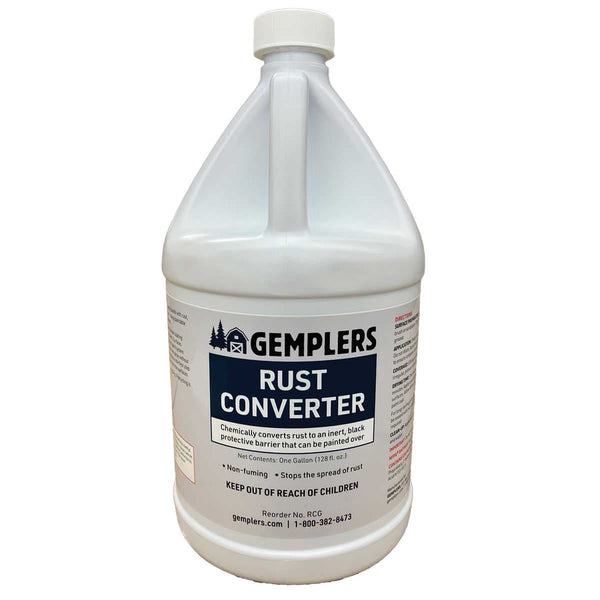
Gempler's Rust Converter is a United States made polymeric treatment aimed at farm, fleet and workshop steel rather than boutique restoration aisles. It turns existing rust into a dark, moisture blocking film that can act as a primer before an oil based topcoat. Users apply it with a brush, roller or pump sprayer after knocking off loose scale.
Two coats are standard on the brushable version, with more passes on sprayable and aerosol packs. The film can stay unpainted in sheltered spots. It is used on buildings, trucks, gates, tanks and implements. Cure before finish paint is typically given as 48 hours, longer in damp air. Aerosol coverage is much smaller than gallon coverage, so large jobs stay with the liquid. The product is non flammable in the bulk form and is marketed as an all in one converter and primer for ferrous surfaces.
-
Key features: Synthetic polymeric converter, brush roller or spray, two to four coats by format, oil based topcoat window, farm and vehicle use.
-
Facts and information: About 500 square feet per gallon on smooth brushable coats. Sprayable liquid nearer 300 square feet per gallon. Aerosol around 24 square feet per can. Touch dry often 20 to 60 minutes. Second coat advised for full conversion.
18. FDC Rust Converter Ultra
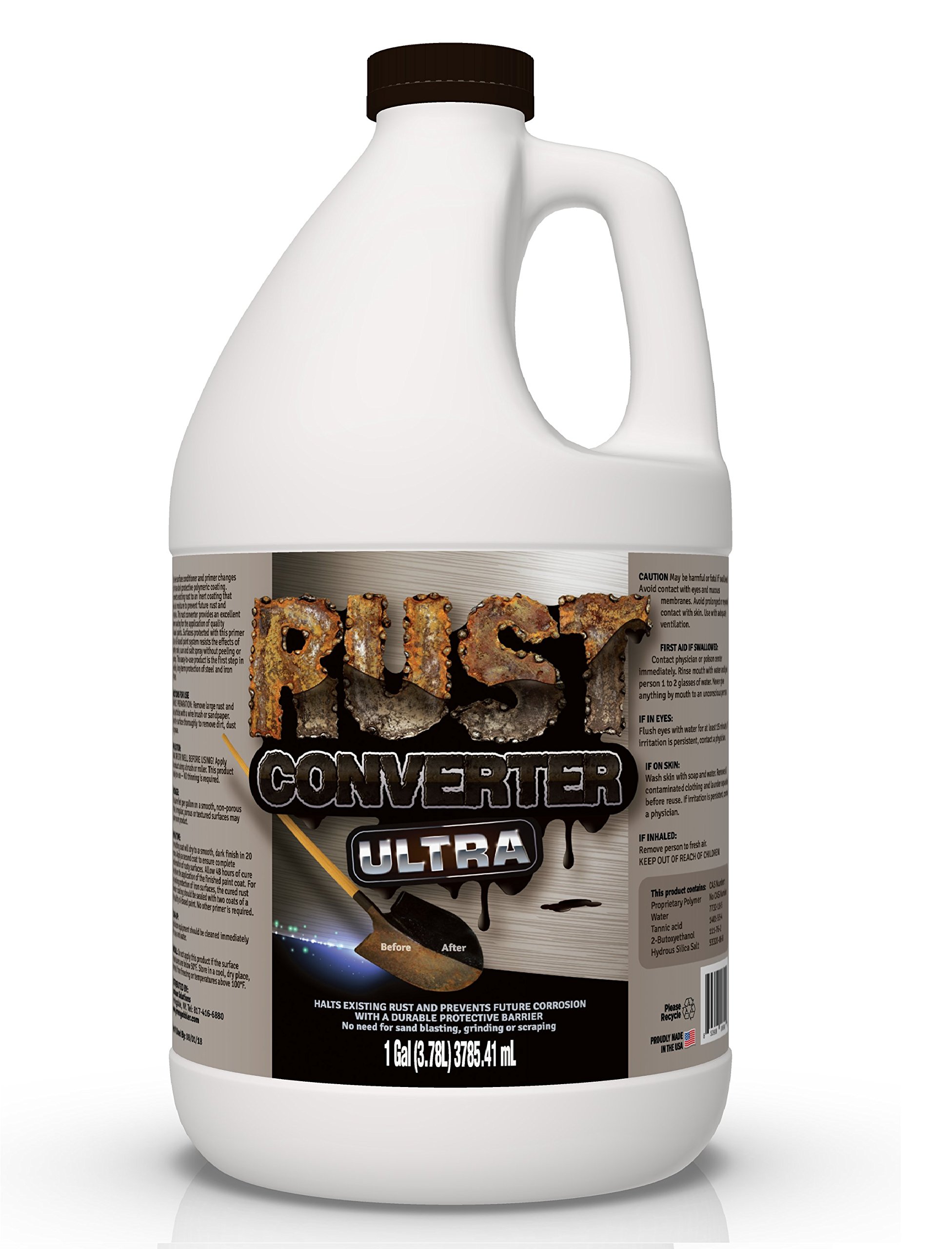
FDC Rust Converter Ultra is a professional grade liquid sold in large United States packs for dumpsters, machinery, railings, vehicles and building steel. It converts rust into an inert dark coating that seals moisture out and can be brushed, rolled or pump sprayed without thinning. On rusted metal it dries matte and opaque. On clean metal it can stay clearer. Prep is limited to removing loose scale, dirt and grease.
A first coat can darken in about 20 minutes, with a second coat used to finish the reaction. Finish paint usually waits 48 hours. The formula is positioned for commercial weather exposure rather than tiny touch up bottles. It does not replace wasted metal, so pitted structure still needs inspection. Coverage claims assume smooth, non porous steel and drop on rough or porous work.
-
Key features: Ready to use liquid, brush roller or pump sprayer, two coat process, matte dark film on rust, commercial and automotive steel.
-
Facts and information: About 500 square feet per gallon on smooth surfaces. First coat dry to a dark finish in about 20 minutes. Full cure before topcoat commonly 48 hours. Marketed as made in the USA for industrial and outdoor metal.
19. Rust Kutter

Rust Kutter is a phosphoric acid based converter distributed from Fort Wayne, Indiana through Sanco Industries and similar industrial channels. The clear liquid attacks iron oxide and is used on tools, equipment and ferrous parts where a thin acid treatment is preferred over a heavy latex film. Safety data lists a high phosphoric acid content plus glycol ether and citric acid, so it is handled as a corrosive cleaner converter rather than a household paint.
It can be brushed, rolled or sprayed, then allowed to react before rinsing or coating according to the label. It is closer in chemistry to classic metal prep acids than to self priming black primers. Users treat it as a step in a coating system, not a standalone finish. Coverage and dwell time vary with rust thickness. It is a trade chemical more than a hardware aisle spray.
-
Key features: Phosphoric acid liquid, industrial pack sizes, brush roll or spray, ferrous rust conversion, rinse or coat per label.
-
Facts and information: Phosphoric acid often listed in the 30 to 55 percent range by older sheets. Specific gravity around 1.25. Boiling point near 220°F. DOT corrosive classification on concentrated packs. Used on equipment and shop steel in the United States.
20. Permatex Rust Treatment

Permatex Rust Treatment, from the well known United States chemical brand in the automotive aftermarket, is an aerosol that goes on light and dries to a black primed film over surface rust. It is built for stone chips, small panels and hardware rather than full chassis recoats. Prep is a dry, degreased surface with loose flake removed.
The spray sets faster than many gallon converters, which is why it shows up in roadside and garage kits. Some technical notes describe a formic acid blend instead of a straight phosphoric system, which changes how it behaves versus Ospho style liquids. It is widely stocked in auto parts stores across the United States. Coverage per can is modest, so large frames need many units. Topcoats follow after the film has fully dried. It is a spot and panel product, not a farm gallon.
-
Key features: Aerosol rust treatment, black primed finish, automotive spot work, fast set, parts store distribution.
-
Facts and information: Common can size around 10.25 ounces. Used on cars, tools and light equipment. Independent panel tests have placed it mid pack for long salt exposure compared with heavy encapsulators. Ready for many conventional topcoats after cure.
21. VHT Rust Converter

VHT Rust Converter is an aerosol from the United States high temperature coatings line, aimed at exhaust adjacent parts, chassis details and small ferrous repairs. It converts rust into a paintable barrier and is used where a spray can reaches better than a brush. Heat resistance is part of the VHT identity, so the converter is often chosen near engine bays and shop fixtures rather than decorative indoor metal.
Loose rust still needs a wire brush. Like other aerosols, film build is thin and several light coats beat one wet coat. Independent outdoor panel tests have shown mixed barrier life versus thicker encapsulating coatings, so a proper topcoat matters. It is a specialty spray in the same family as VHT engine and header paints, not a five gallon industrial converter.
-
Key features: Aerosol converter, ferrous metal, shop and vehicle details, paintable barrier, high temperature brand line.
-
Facts and information: Typical automotive 10 ounce class can. Appears in United States restorer and racer catalogs. Heat focused brand heritage. Better suited to accessible rust than deep box sections. Topcoat recommended for weather exposure.
Benefits of Regular Rust Maintenance
Keeping up with rust prevents costly repairs down the line. Treated metals last longer in wet or coastal spots. Some rust treatments add shine or colour options for better looks. Regular checks spot issues early.
|
Aspect |
Rust Treatment Paint Benefit |
Regular Paint Difference |
|
Corrosion Control |
Forms barrier against moisture |
May allow rust underneath |
|
Surface Prep |
Minimal scraping needed |
Requires full rust removal |
|
Durability |
Extends metal life in harsh conditions |
Shorter protection span |
|
Application Ease |
Often one-step process |
Multiple layers required |
Common Application Tips for Best Results
-
Start with a wire brush to loosen flakes.
-
Test small areas first.
-
Apply in thin coats for even results. Work in dry weather to avoid streaks. For complex shapes, use aerosols.
-
After drying, add a sealant like waxoil aerosol spray for extra guard.
Factors to Consider When Selecting Rust Treatment Paint
-
Think about the metal type and exposure level.
-
Vehicles need tough formulas against road salt.
-
Tools benefit from quick-dry options.
-
Read labels for compatibility with topcoats.
-
The best rust converter paint can guide you.
-
Pick based on project size.
Rust Converter vs Rust Remover vs Primer vs Encapsulator: Which Do You Need?
These four treatments sit in the same cupboard, yet they do different jobs. Mix them up and the rust keeps moving under the finish. A rust treatment is chosen when the metal still has iron oxide on it and the next coat needs a stable base.
Rust remover dissolves iron oxide and lifts it off. Bare steel is left behind. That clean metal flash-rusts fast if it stays wet or sits overnight. Remover suits tools, small parts, fuel tanks, and jobs where the old rust must go so the surface can be judged and repaired. A rust remover gel stays put on upright panels. A thick liquid rust remover is used on wheel arches and chassis where drips would stain paint. Original rust remover liquid trigger spray reaches seams that a brush misses. Heavy duty rust remover formulas stay active on thick scale long enough for the oxide to break.
Rust converter leaves the rust in place and changes it. Tannic or phosphoric chemistry turns red iron oxide into a dark, stable film. That film blocks moisture, air and carbon dioxide and accepts most oil-based or epoxy topcoats. Converter suits tight rust on large panels, gates, underbodies and spots that cannot be blasted clean. A rust converter liquid covers broad steel. Rust converter liquid trigger spray covers the same chemistry in a wider pass. A rust converter epoxy aerosol reaches box sections and inner wings. The colour shift to purple-black is the visual cue that the reaction has taken hold. Automotive rust converter products follow this same reaction on chassis steel.
Anti-rust primer is the next layer after the metal is stable. It is not a rust killer on its own. Primer grips the treated steel and gives the colour coat something to hold. Zinc-rich anti-rust primer spray paint is used on iron, steel and aluminium after remover or converter has done its work. Skip this step on outdoor metal and the topcoat peels sooner.
Encapsulator and direct-to-rust paint seal the surface rather than strip it. They form a dense film over remaining rust and keep water out. Direct to metal paint is used when loose scale is gone and a colour finish is wanted in fewer coats. Directorust acts as primer, undercoat and topcoat on wood, metal, plastic and rusted steel once flakes are brushed off. Anti-rust paint then holds the colour in weather.
A short way to sort the job:
-
Want shiny bare metal back? Use rust remover liquid, then prime the same day.
-
Want to stop rust and paint over it? Use converter, wait for a full cure, then topcoat.
-
Want grip for enamel or acrylic? Use primer on stable metal.
-
Want a sealed colour coat with less prep? Use a direct-to-rust system after the loose rust is gone.
The rust remover vs rust converter choice also depends on access. Hollow legs, sills and chassis rails favour spray or dip. Flat gates and tools favour brush or gel. Holes and paper-thin steel still need metal repair. No chemical layer puts strength back into metal that has already wasted away. Epoxy repair fills small voids before any coating goes on.
Cars add another layer. After conversion, motor care products such as Waxoil aerosol and bitumen undercoat keep salt and road water off the treated steel. Underbody rust protection is that extra skin on chassis rails and wheel wells. Garden metal follows the same order: treat, prime or encapsulate, then a weatherproof finish.
How to Prepare and Apply Rust Treatment Paint Step by Step
Prep decides whether the coat lasts a season or many winters. How to remove rust from a car follows the same order used on gates, tools and trailer frames: clean, knock off scale, treat, dry, then protect.
1. Clean the surface
Wash off salt, mud, oil and wax. Grease stops acids and converters from touching the rust. Dish soap and warm water work on light dirt. Degrease stubborn film. Let the metal dry fully. Damp steel slows the reaction and can leave pale patches. Surface cleaners belong in this first pass when wax or road film is thick.
2. Remove loose rust and failed paint
A wire brush, drill brush or coarse abrasive takes off flakes and blisters. Tight, bonded rust can stay if a converter is next. Loose scale must go. Converter and encapsulator both fail on crumbs that have no grip. On vertical car panels a non-drip rust remover limits run-off onto good paint. Chrome and other soft finishes need a lighter hand.
3. Match the treatment to the rust
Light surface bloom and thin oxide after blasting suit a spray-on rust remover. Heavy pits on sound steel suit a rust neutraliser. Small tools and cookware can soak in original rust remover liquid or non-hazardous rust remover liquid when gloves-off handling matters. Keep the film wet while it works. If it dries too soon, the reaction stops early.
4. Apply thin, even coats
Brush for edges and ornate iron. Trigger spray for large flats. Aerosol for inner wings and box sections. Two thin coats beat one heavy coat. Heavy coats skin over and trap unreacted rust underneath. Anti rust spray formats help on awkward shapes where a brush leaves ridges.
5. Give it time to finish the job
Remover usually leaves metal ready to prime after a short dwell, once residue is wiped. Converter darkens as it works. Touch-dry is not full cure. Full cure is when the film is hard enough for paint. Cool, damp air stretches that window. Warm, dry air shortens it. Label times on each tin in the rust treatment range still rule the clock.
6. Rinse only when the formula asks for it
Many converters are leave-on systems. Wiping a fresh converted film can strip the new barrier. Removers that lift rust as sludge often need a wipe or rinse so primer sees clean steel. Neutral, water-based removers used as a soak are rinsed and dried before flash rust starts.
7. Prime or topcoat at the right moment
Once converter has cured, oil-based enamel and epoxy coats bond well. Water-based household emulsion often sits on the film and peels later. Anti-rust primer sits between treated steel and the colour coat when extra grip is needed. Rust shield clear metal lacquer seals bright metal when the original look should stay visible. Clear metal lacquer is the same idea across bare steel and already painted metal.
8. Protect hidden steel
Wheel wells, sills and chassis rails stay wet after rain. After treatment, a flexible Waxoil film or bitumen undercoat keeps water and grit off the converted layer. A car rust proofing kit groups those steps for a full underside.
Work in dry weather. Mask good paint. Shake aerosols until the ball rattles. Hold the can far enough away for a mist, not a puddle. Test a small patch when the metal type is unclear. Galvanised, aluminium and stainless need a different approach than bare mild steel. A galvanised metal restore kit is built for zinc-coated fencing and doors rather than raw ferrous rust.
Latest News In 2026
Rust treatment in 2026 has moved toward systems, not single tins. UK makers now pair a converter or remover with a primer, a colour coat and a cavity or underbody film so the treated steel is not left bare after the first reaction.
Water-based rust converters remain the default for home workshops because odour is lower and clean-up is simple. Epoxy aerosol converters are used more on cars, where spray reach matters more than brush control.
Underbody work has its own track. Clear wax films keep chassis rails inspectable. Black bitumen films take grit on wheel arches. Heavy corrosion still starts with strip-back chemistry. Thicker gels and heavy duty rust remover formulas stay on vertical steel long enough to loosen scale before any converter goes on.
Finish coats have split too. Zinc-rich anti-rust spray paint is used as a sacrificial base. Clear anti rust spray for metal keeps polished or aged metal looking as it is. Anti rust coating spray is the clear-barrier version of that idea. Project kits now bundle remover, brush and finish for radiators, BBQs and galvanised fencing so the steps stay in order. A BBQ restore kit is one example of that bundled sequence.
FAQ
What makes rust treatment paint different from standard paint?
Rust treatment paint chemically interacts with corrosion to convert it into a stable compound, providing a protective layer that prevents further oxidation. Standard paint, on the other hand, simply acts as a surface cover without addressing underlying rust issues, which can lead to peeling over time.
How long does rust treatment paint last once applied?
The durability of rust treatment paint depends on environmental factors like humidity and exposure to elements, but proper application ensures extended protection against corrosion recurrence. Adding a topcoat enhances resistance to wear and tear in demanding conditions. Advancements in water-based options have improved longevity by creating tighter bonds with metal surfaces.
Can I use rust treatment paint on non-metal surfaces?
Rust treatment paint is formulated specifically for ferrous metals such as steel and iron, where it effectively neutralises corrosion. On non-metal materials like aluminium or galvanised surfaces, it may not perform as intended and could require alternative treatments.
Is rust treatment paint safe for indoor projects?
Water-based rust treatment paints feature low volatile organic compounds, making them suitable for enclosed spaces with minimal health risks. Proper ventilation during application helps disperse any mild odours, and gloves protect skin from direct contact. Newer developments focus on non-toxic ingredients to support safer use in home environments.
How should I store rust treatment paint for future use?
Store rust treatment paint in a cool, dry area to preserve its chemical stability and prevent separation of components. Ensure lids are sealed tightly after each use to avoid evaporation or contamination. For products like anti-rust primer spray paint, upright positioning in storage prevents leaks and maintains spray functionality.
Can rust treatment paint repair holes or thin metal?
Conversion and removal freeze the chemistry. They do not rebuild thickness. Thin lips, pinholes and crumbling seams still flex and crack any film that sits on weak steel. Cut out or patch the wasted metal first, then treat the sound edge. Repair products and epoxy putty bridge small voids so the rust coat has a solid seat.
Should rust converter be rinsed after it turns black?
The dark film is the new barrier. Washing it while it is still soft peels that barrier off and leaves active rust behind. Leave-on converters dry in still air. Removers that turn rust into sludge are the exception, because leftover slurry blocks primer. If the label calls the product a converter, the black layer stays.
Can rust treatment paint go over old sound paint?
Converter needs iron oxide. Intact gloss has none, so the liquid sits as a weak skin and later chips with the old enamel. Treat only the break where rust shows, then feather the edge into the sound paint. A keyed, rust-free panel takes anti-rust primer or direct to metal paint instead of a converter.
What happens if rain hits the coat before it cures?
Unreacted liquid thins, runs and leaves pale tracks. Water also sits under a half-set film and keeps oxygen on the steel. The colour change can stall, which means the oxide never fully locked. A second dry-weather coat on the same cleaned area is how that patch is recovered. Outdoor jobs wait for a window that covers full cure, not just the first dry touch.
How many coats of rust converter are needed?
One wet, even pass is the normal film on light bloom. Deep pits drink the first coat and can show raw orange in the pores. A second thin pass after the first has darkened fills those pores without building a soft ridge. Puddles stay tacky and collect dust. Coverage on the tin is a guide for flat steel, not for pitted chassis.
Will rust return under a converted surface?
The converted layer is a seal, not a miracle skin. Stone chips, flex cracks and missed seams let salt water back in. Road chlorides are the usual trigger on cars after a wet winter. A cured converter plus a closed finish from anti-rust coatings or waxoil keeps that water off the steel. Hidden sills need the same seal on the inside face, not only on the visible panel.
Can rust treatment paint be used on galvanised or aluminium parts?
Ferrous converters are tuned for iron oxide. Zinc and aluminium form different oxides, so the colour change may never appear and the film can stay weak. Those metals use products written for them, such as a galvanised metal restore kit or an etch primer from the paints and primers range. A test patch on a hidden flange shows whether the liquid wets and dries as a bonded film.
Is a rust converter the same as direct-to-rust paint?
Converter changes oxide into a dark, paint-ready compound. Direct-to-rust paint builds a coloured film over prepared rust and often acts as primer and finish in one. Some jobs use both: converter on the active rust, then a colour system from anti-rust paint or Directorust. The converter is the chemical step. The paint is the weather skin.
Can I treat rust inside a bike frame or car sill?
Inner steel rusts from trapped water, not from the side you can see. Aerosol converters and cavity wax with a straw coat that hidden face if drain holes and seams are open. Blocked sills hold the liquid in a puddle and it never forms an even film. How to stop a bike rusting and underbody rust protection both treat the inside path as part of the same job as the outer coat.
Read Also
Discover Our Best Rust Treatment Paint in 2026 - Jenolite



